The Best Quiz Funnel for Hair Loss DTC Brands: A Technical Breakdown of Spartan
If you sell a hair-loss product direct-to-consumer, you are fighting three problems at once: it's a sensitive, embarrassing category, it's crowded with finasteride telehealth players and gas-station biotin gummies, and the buyer is skeptical because they've already wasted money on things that didn't work. A static product page can't handle all three. A quiz funnel can — because it lets the prospect diagnose themselves, on their own terms, before you ever pitch.
Spartan runs one of the best examples in the category. It's a men's hair-loss brand selling a DHT-blocking Root Activator Shampoo, positioned as a simple 2-minute hair wash ritual for thicker, fuller hair in as little as 10 weeks. On an estimated $5–8M/month at roughly 1M visitors/month, the entire acquisition engine funnels cold traffic through an 18-step quiz that ends on a personalized bundle offer.
Below is a full technical teardown — all 18 steps, screenshot by screenshot — with a note on what each screen is actually doing mechanically. This is the blueprint to steal from if you're building a hair-loss (or any sensitive-health) quiz funnel.
The one-line thesis: Spartan's funnel is a diagnostic-to-prescription machine. Every question is framed as medical intake, not marketing. By step 14 the prospect has effectively diagnosed their own condition, so the shampoo lands as a prescription they asked for, not a product being sold to them.
Step 1 — Age Gate as the first micro-commitment
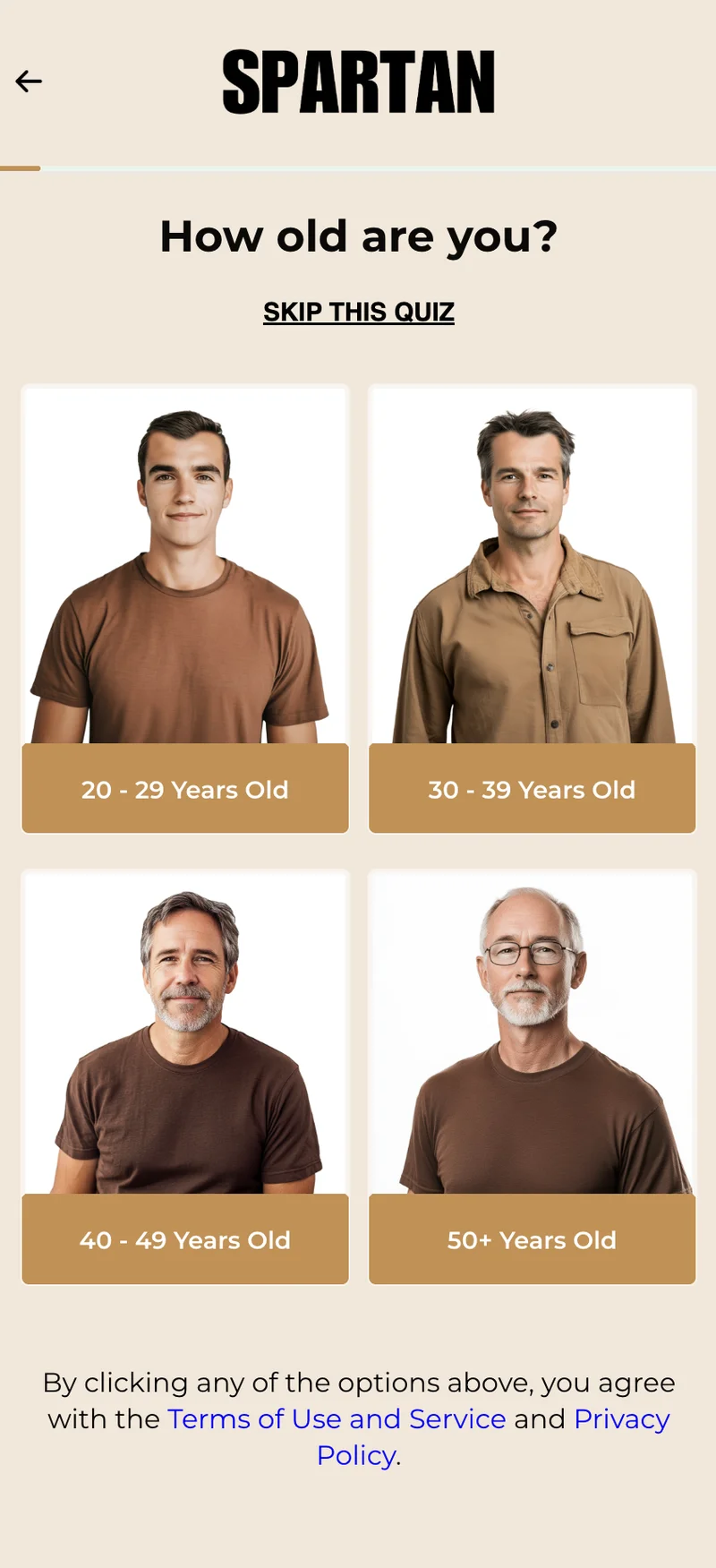
The funnel opens with "How old are you?" as four photo tiles (20–29, 30–39, 40–49, 50+), not a "start quiz" button. This is deliberate on every axis:
- The first tap is frictionless and non-threatening. Age is the one question no one is embarrassed to answer, so it earns the initial commitment before asking anything sensitive.
- Photo tiles do covert self-identification. The prospect picks the man who looks like them — instant projection and relevance.
- It's an age gate that never feels like one. No "quiz" language, no intro screen, no value-prop paragraph. The word "quiz" appears only in the tiny "skip this quiz" link (a reverse-psychology nudge), and the legal consent sits quietly at the bottom, cleared by the first tap.
Steal this: never open with "Take our 2-minute quiz." Open with a single, low-stakes, self-identifying tap. Momentum is the whole game on step 1.
Step 2 — Location of the problem (the medical-intake frame begins)
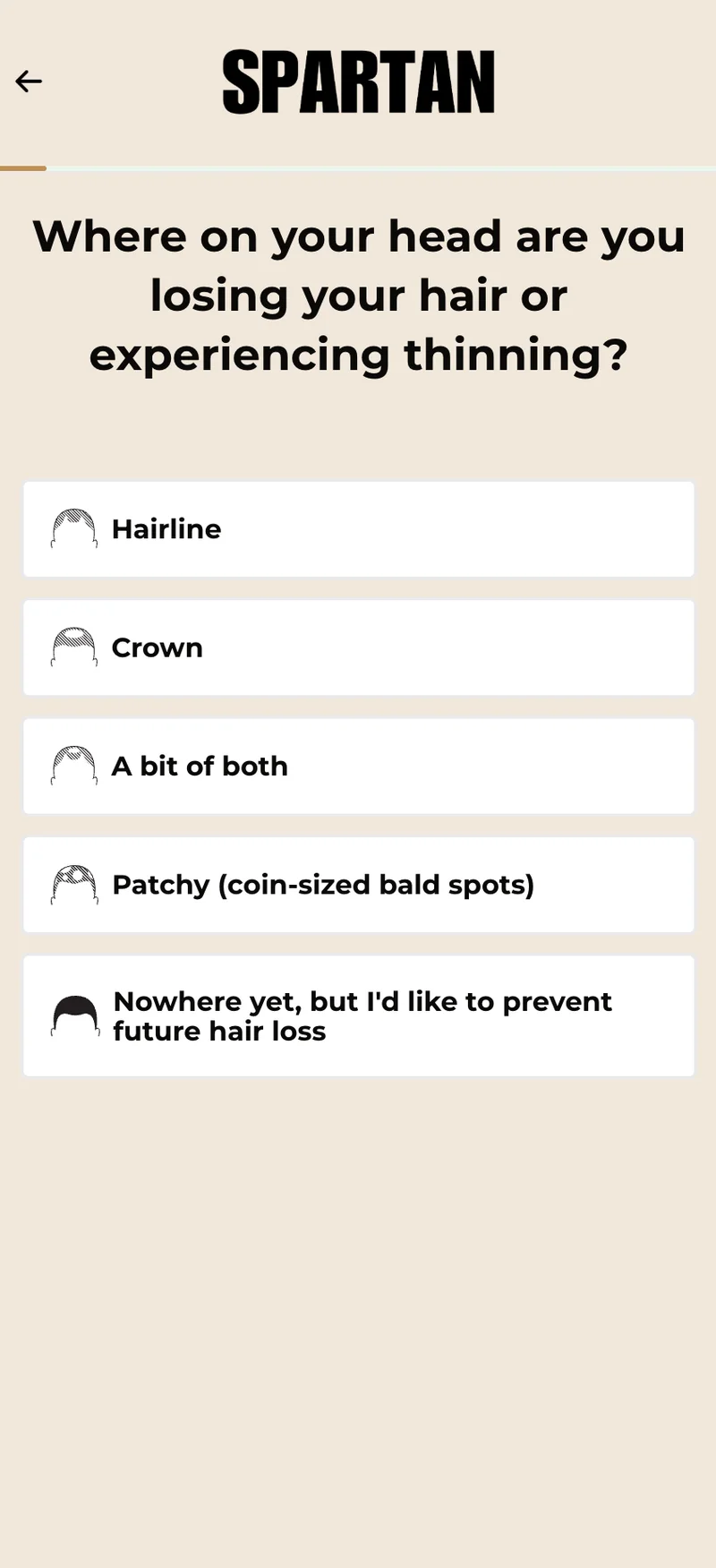
"Where on your head are you losing your hair or experiencing thinning?" — Hairline, Crown, A bit of both, Patchy, or "Nowhere yet, but I'd like to prevent future hair loss." Each option gets a small illustrative icon.
Two things are working here. First, the question reads like a dermatologist's intake form, which frames the whole experience as a diagnosis rather than a sale. Second, that last option — "nowhere yet, prevent" — widens the top of the funnel to capture prevention-minded buyers who don't yet have visible loss. Nobody disqualifies themselves.
Step 3 — Symptom qualifier
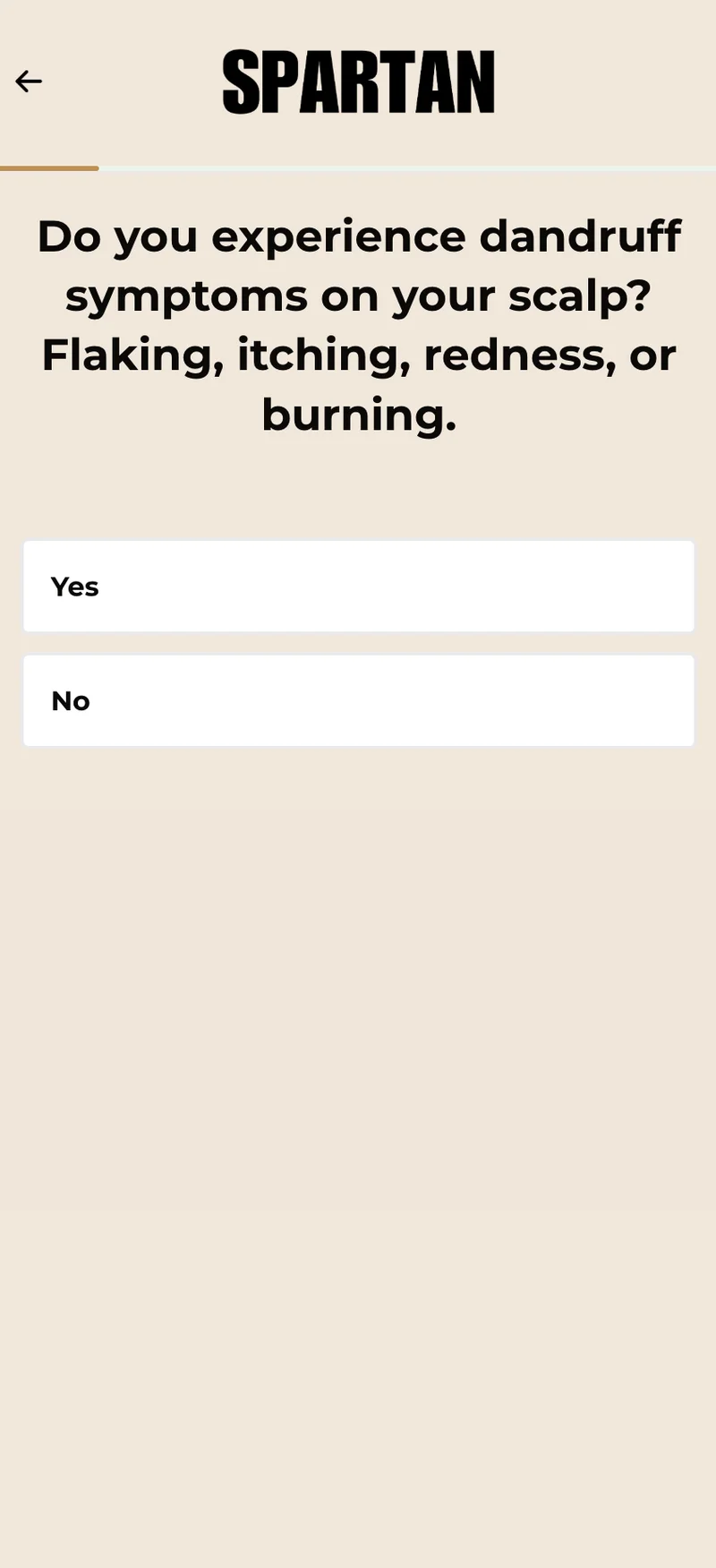
A simple binary: "Do you experience dandruff symptoms on your scalp? Flaking, itching, redness, or burning." Yes / No.
This looks like data collection, but its job is belief-building: it plants the idea that scalp health (not just genetics) drives hair loss — which is exactly the mechanism the Root Activator Shampoo addresses. The quiz is quietly teaching you the problem it's about to solve.
Step 4 — Severity
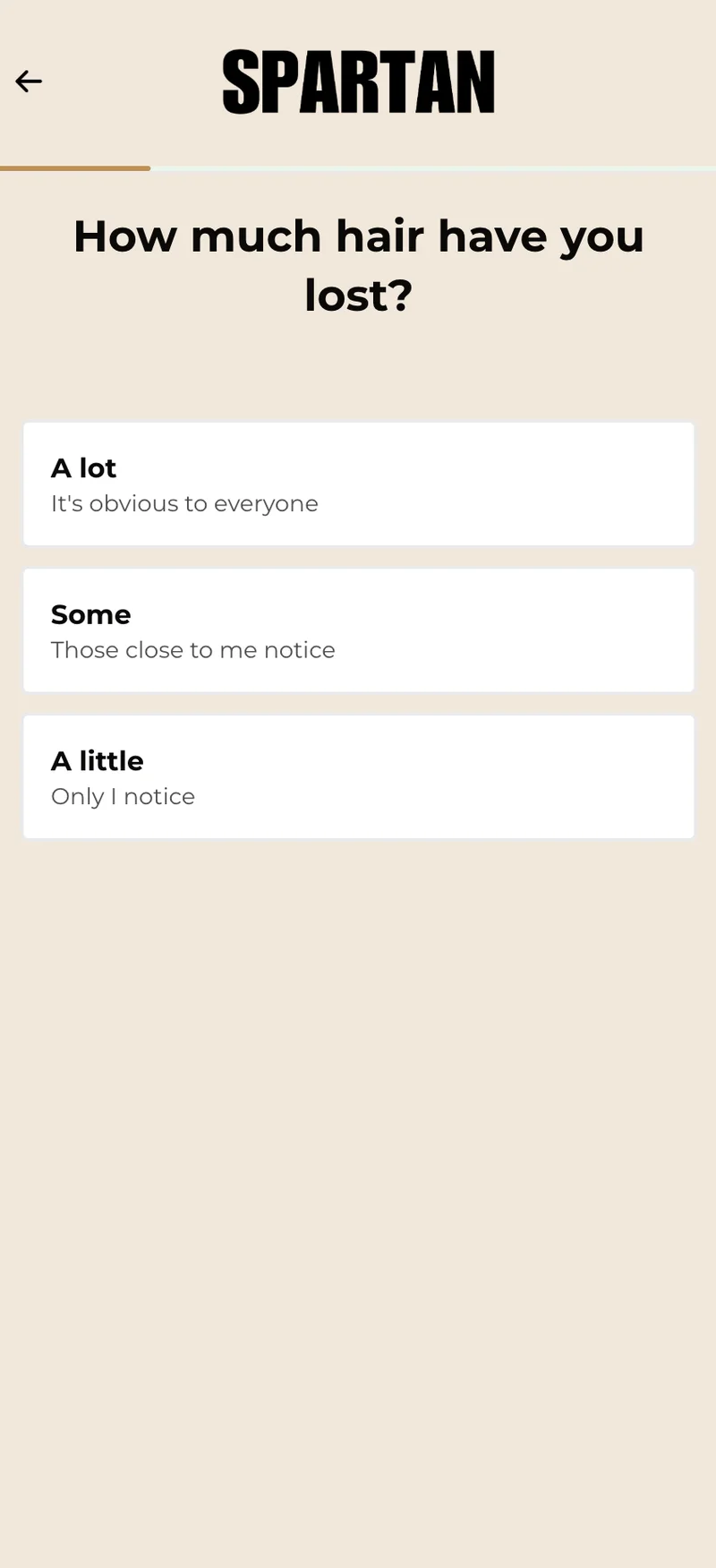
"How much hair have you lost?" — A lot / Some / A little, each with a self-assessment subtitle ("It's obvious to everyone" … "Only I notice"). This escalates the emotional stakes and gets the prospect to admit the severity in their own words — a small confession that increases their investment in finding a fix.
Step 5 — Timeline of onset
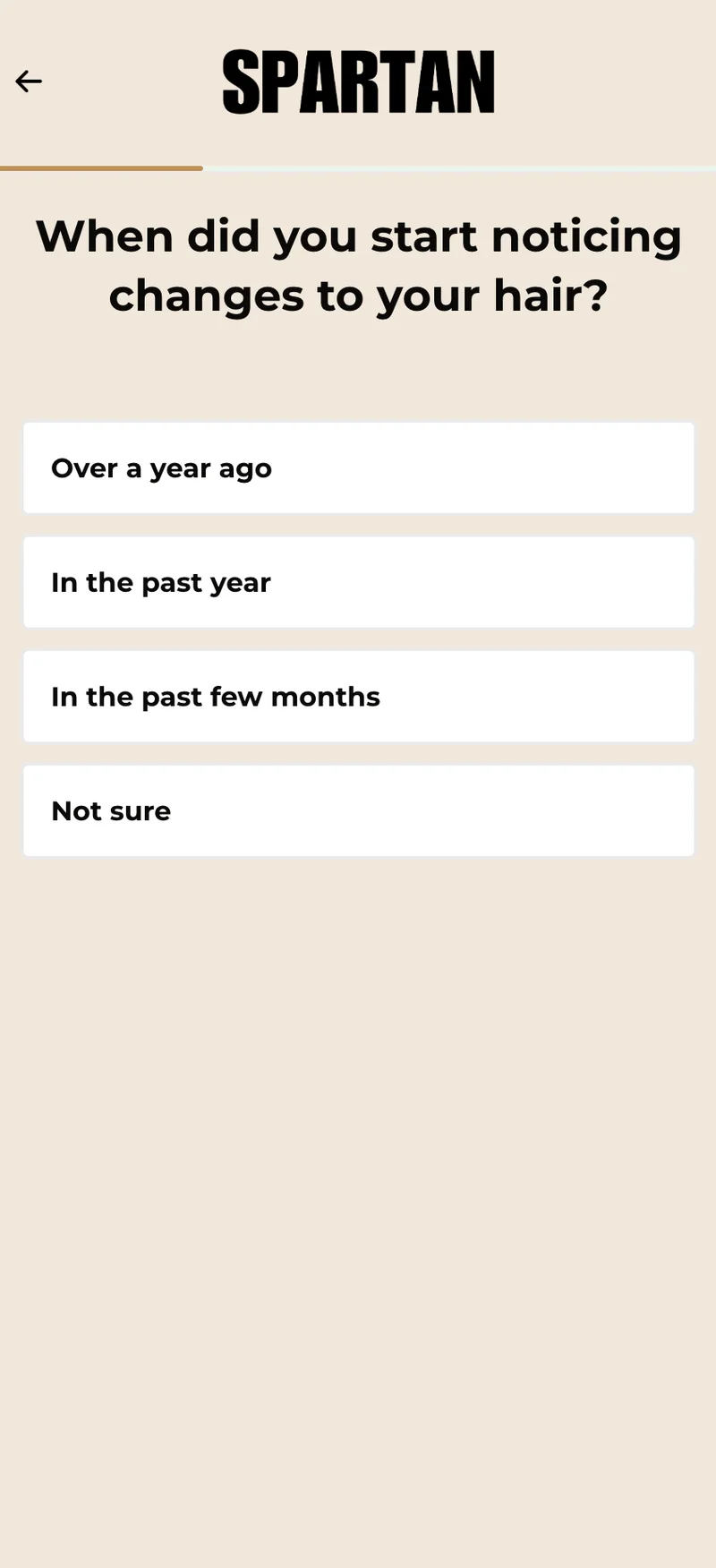
"When did you start noticing changes to your hair?" More intake-style data, and another dimension the final "profile" and timeline projection will reference to feel personalized. Notice the pattern: Spartan is stacking specificity. Every answer is another variable it can later reflect back to make the result feel custom-built.
Step 6 — Goals (multi-select = the wish list)
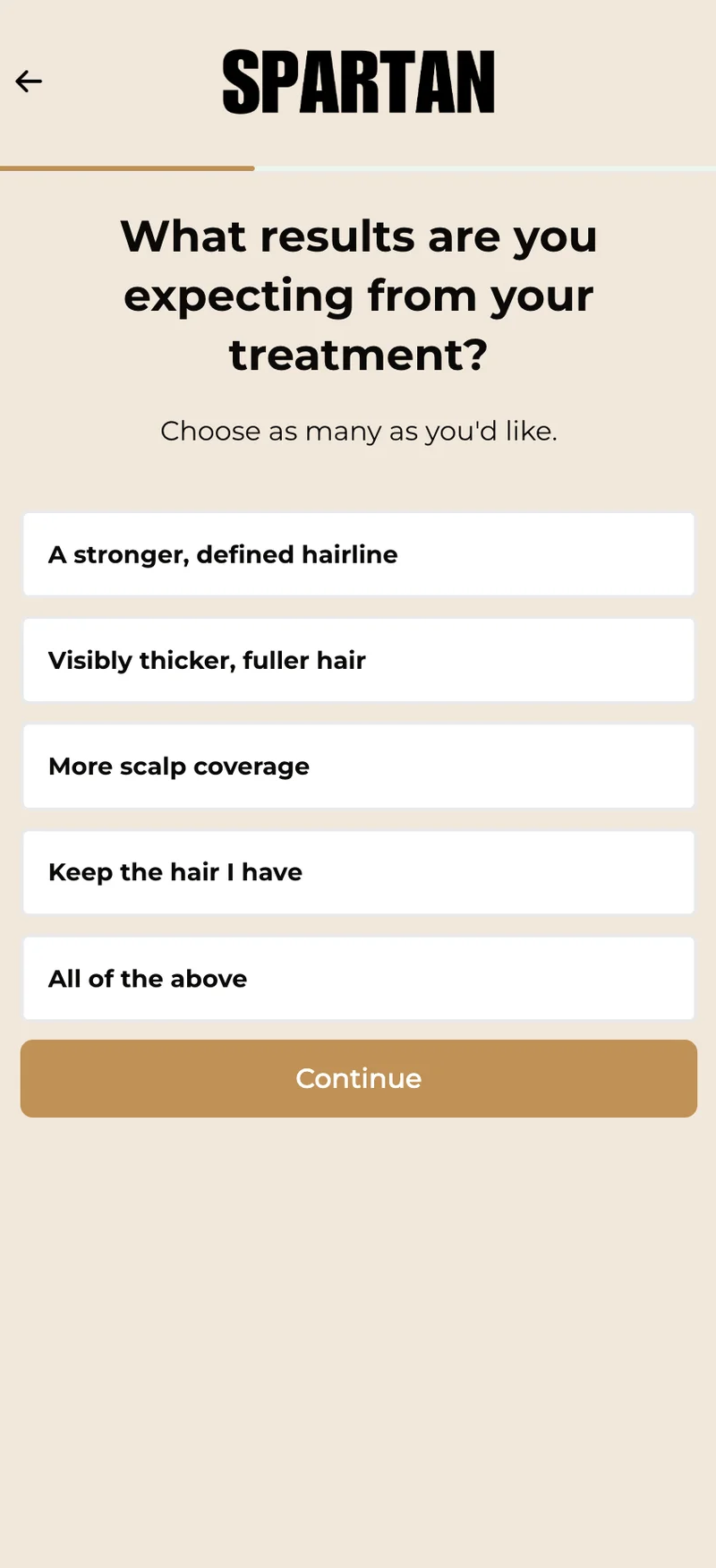
"What results are you expecting from your treatment? Choose as many as you'd like." — stronger hairline, thicker fuller hair, more scalp coverage, keep the hair I have, all of the above.
This is the pivotal psychological step. Multi-select lets the prospect build their own wish list of desired outcomes — and the more boxes they tick, the more they've articulated their desire. The offer at the end can then be positioned as delivering exactly the list they just wrote. This is the first screen with a Continue button (multi-select needs a submit), a deliberate friction change from the auto-advance single-selects.
Step 7 — Social proof interstitial
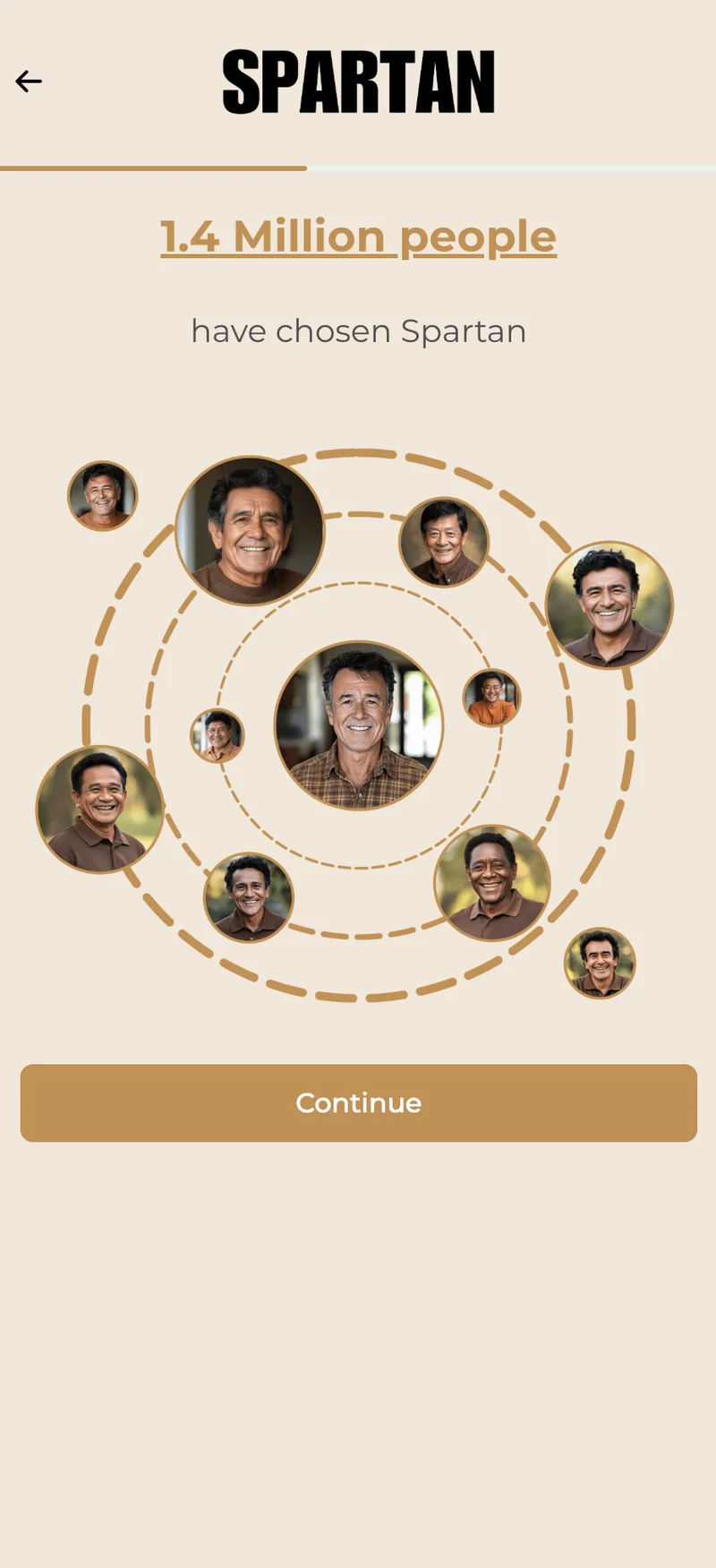
Placed exactly at the mid-funnel fatigue point: "1.4 Million people have chosen Spartan," with a cluster of customer faces orbiting a center portrait. No question — it's a belief-and-momentum interstitial that rewards the prospect for continuing and reduces the risk they feel about where this is heading.
Steal this: break your quiz's question rhythm every 3–4 steps with a non-question "reassurance" screen — social proof, a mechanism explainer, or a motivation line. It resets attention and lifts completion rates.
Steps 8–10 — Low-stakes profiling (the easy middle)
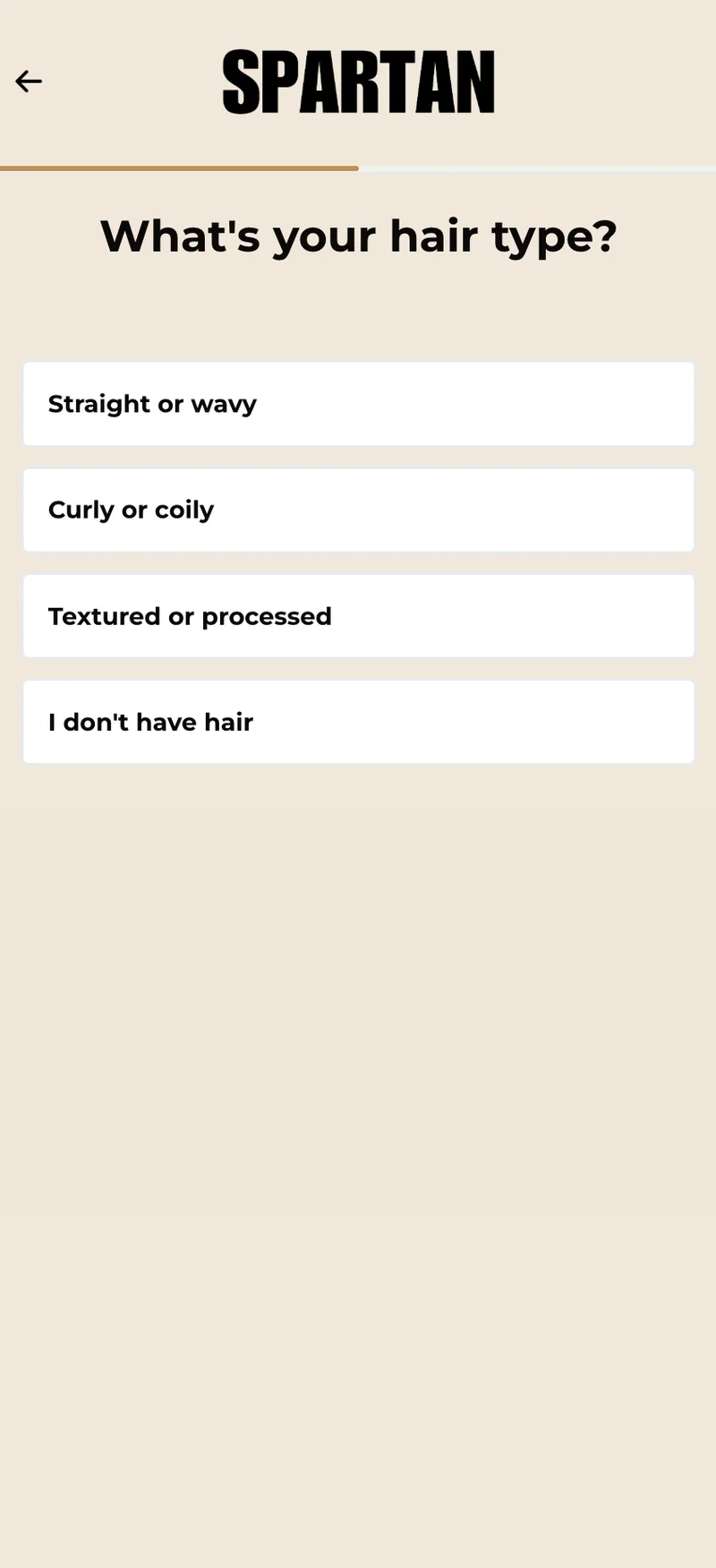
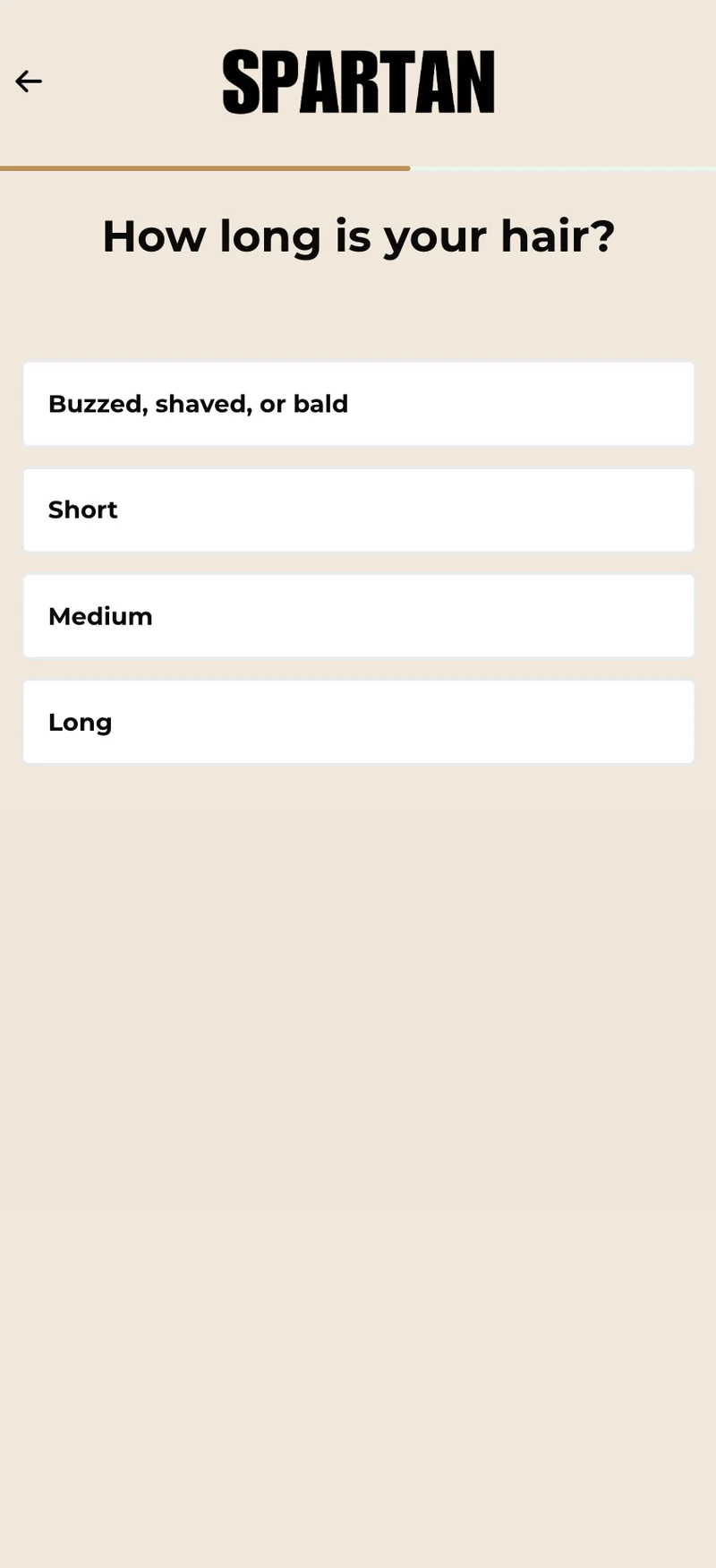
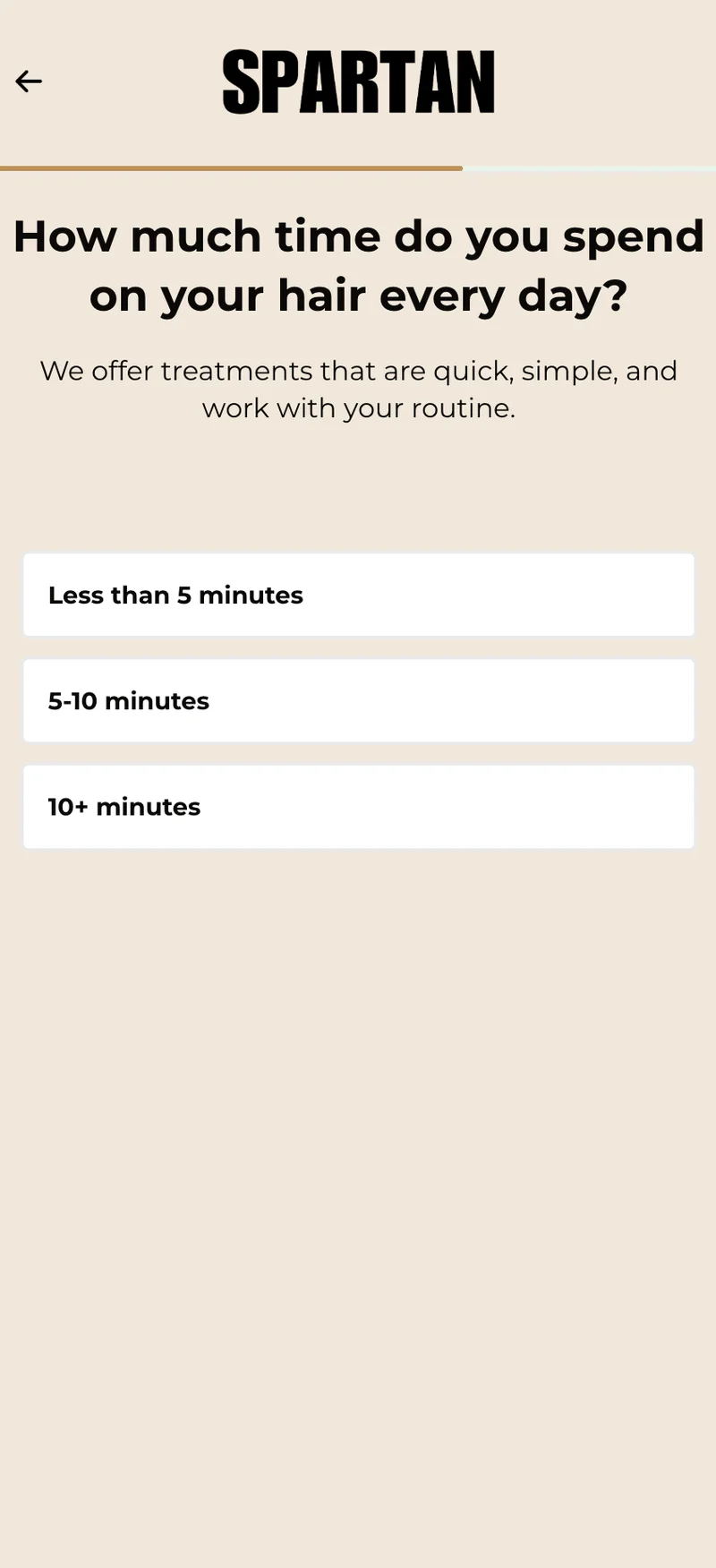
Hair type, hair length, and "How much time do you spend on your hair every day?" These are easy, non-emotional questions that keep the completion streak alive after the heavier severity questions.
Step 10 does double duty: its subtitle — "We offer treatments that are quick, simple, and work with your routine" — pre-frames the core product promise (the 2-minute ritual) inside what looks like a neutral question. Whatever the prospect answers, the "less than 5 minutes" solution is already implied.
Step 11 — Motivation transition (the emotional gut-punch)
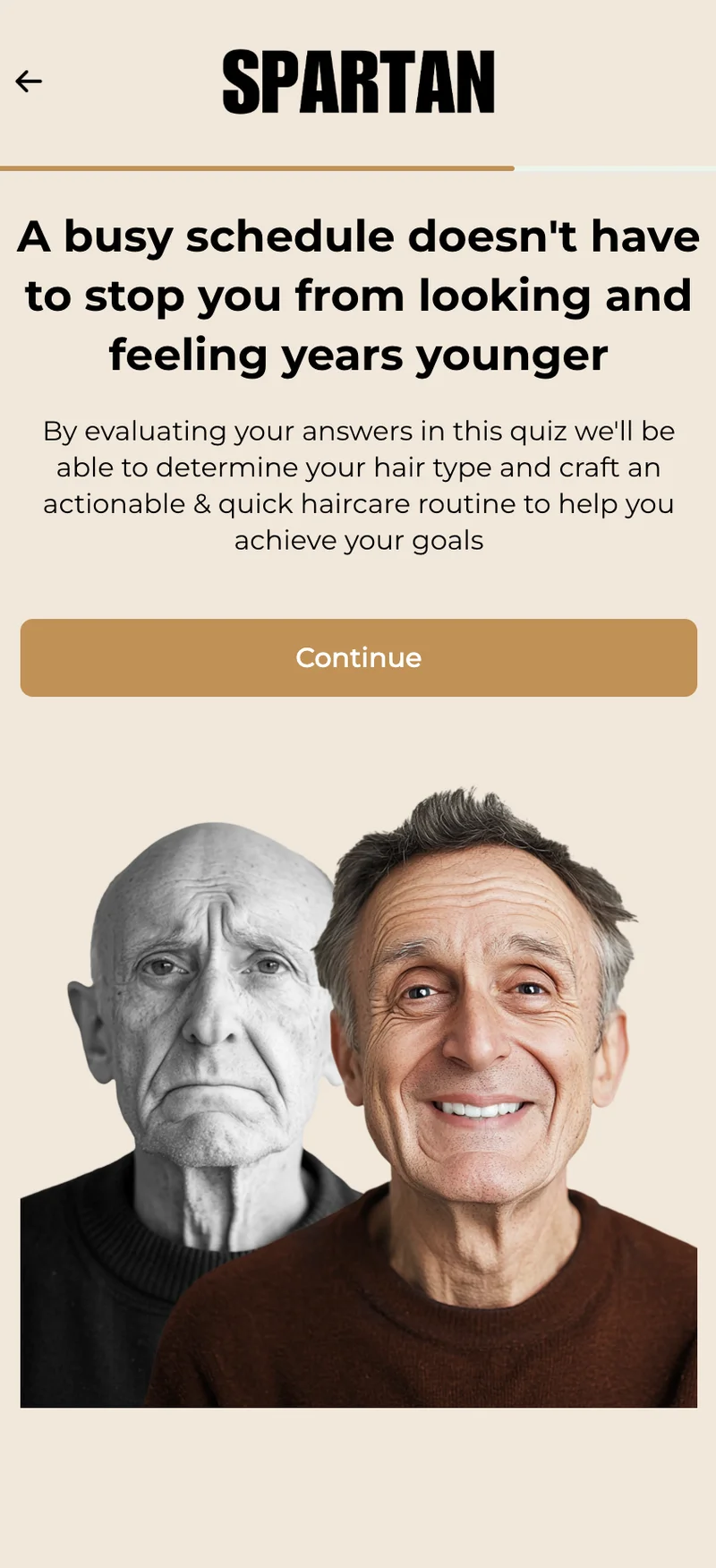
A full-bleed before/after style image of an older, worn face beside a younger, vibrant one, headlined "A busy schedule doesn't have to stop you from looking and feeling years younger." Body copy reassures that the quiz is crafting an actionable, quick routine.
This is a pure emotional interstitial — it sells the identity transformation (feeling years younger), not the product. Placed right before the final data questions, it re-injects desire at the moment fatigue would otherwise set in. Hair loss is an identity wound; this screen speaks to it directly.
Step 12 — Family history (the absolution mechanism)
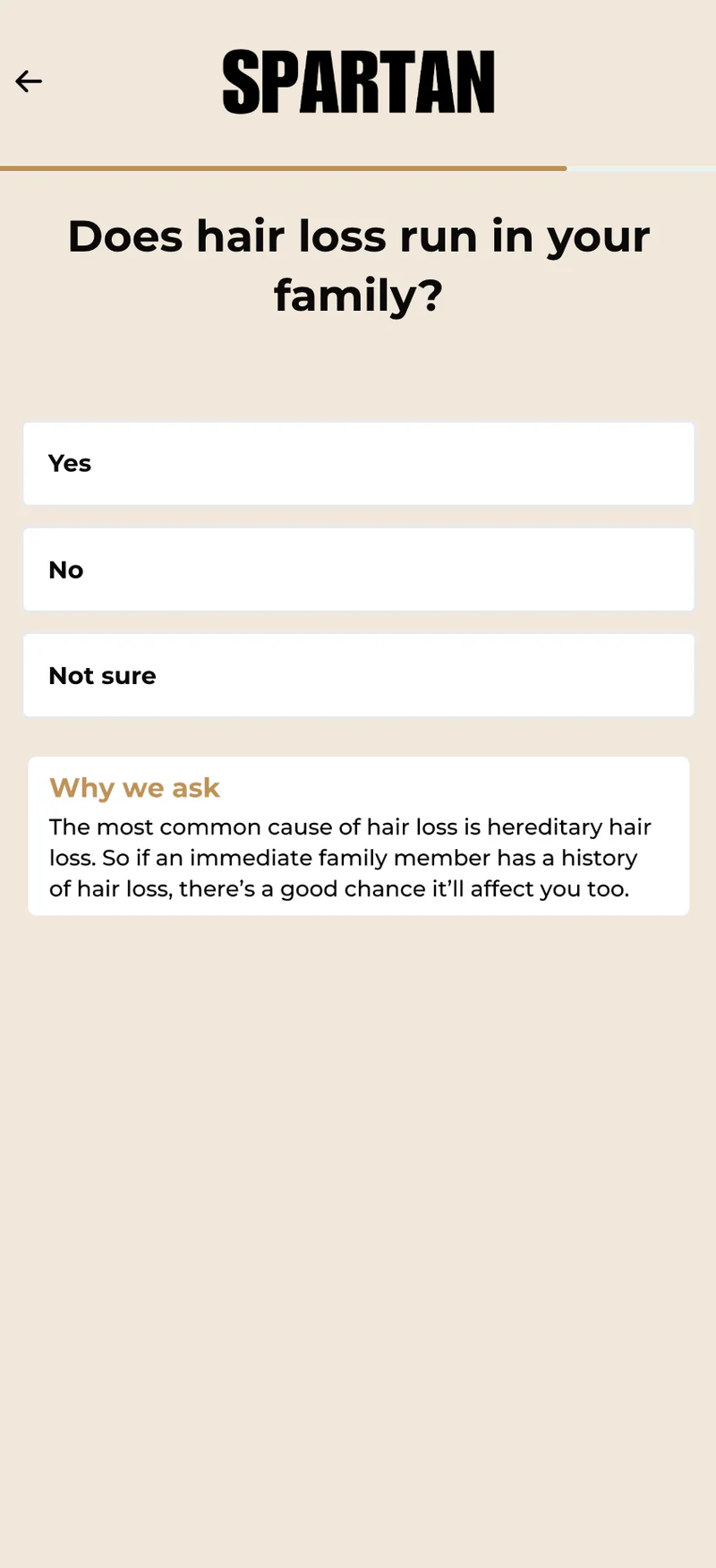
"Does hair loss run in your family?" with a "Why we ask" explainer noting hereditary DHT-driven loss. This is doing quiet but critical work: absolution. By attributing hair loss to genetics and DHT, it removes shame and self-blame ("it's not your fault, it's your biology") — which lowers the defensiveness that kills conversions in sensitive categories. It also sets up the DHT-blocking mechanism the product is built on.
Step 13 — Stress (second mechanism thread)
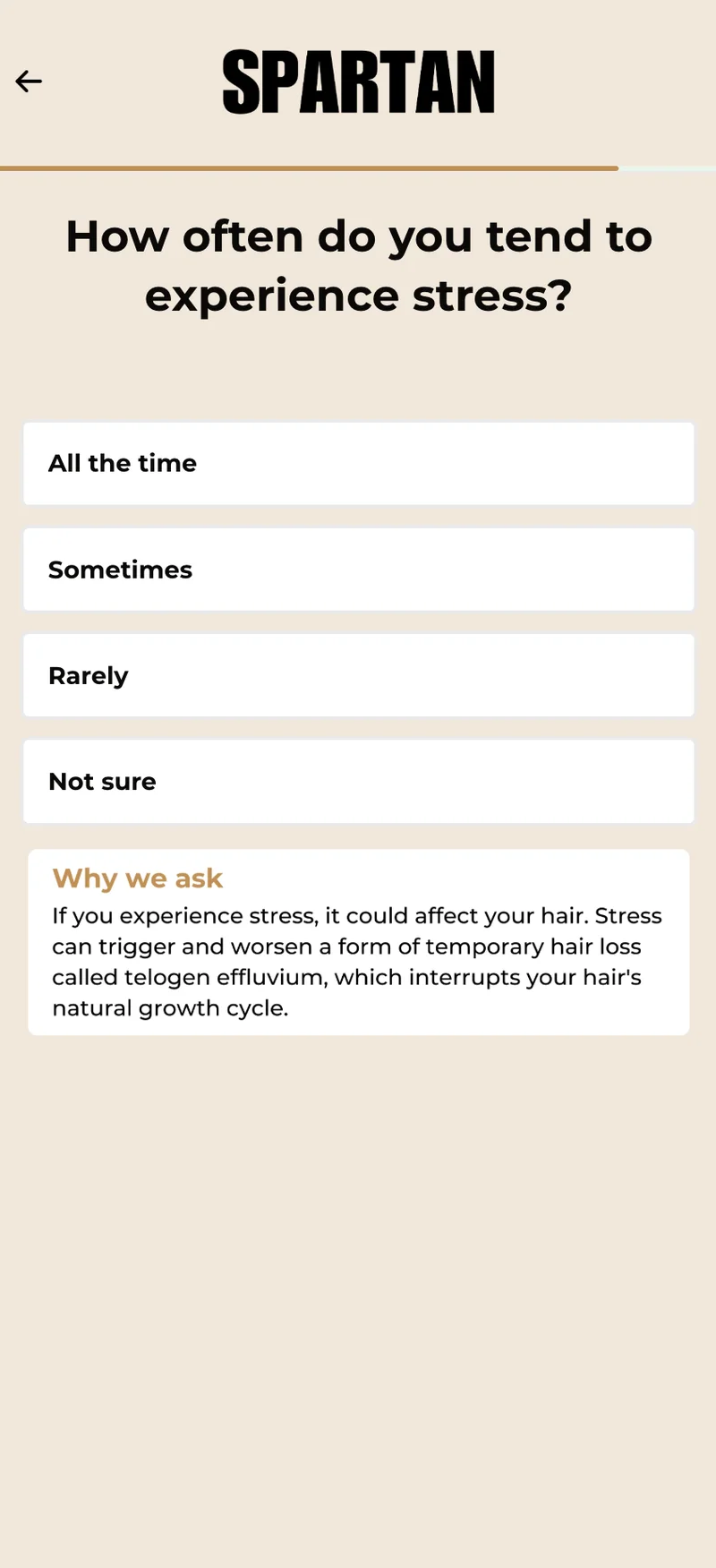
"How often do you tend to experience stress?" with a "Why we ask" note on telogen effluvium interrupting the growth cycle. A second credibility-building mechanism thread — the quiz demonstrates real domain expertise, which makes the eventual recommendation feel medically grounded rather than sales-driven.
Step 14 — The Hair Profile Summary (the payoff)
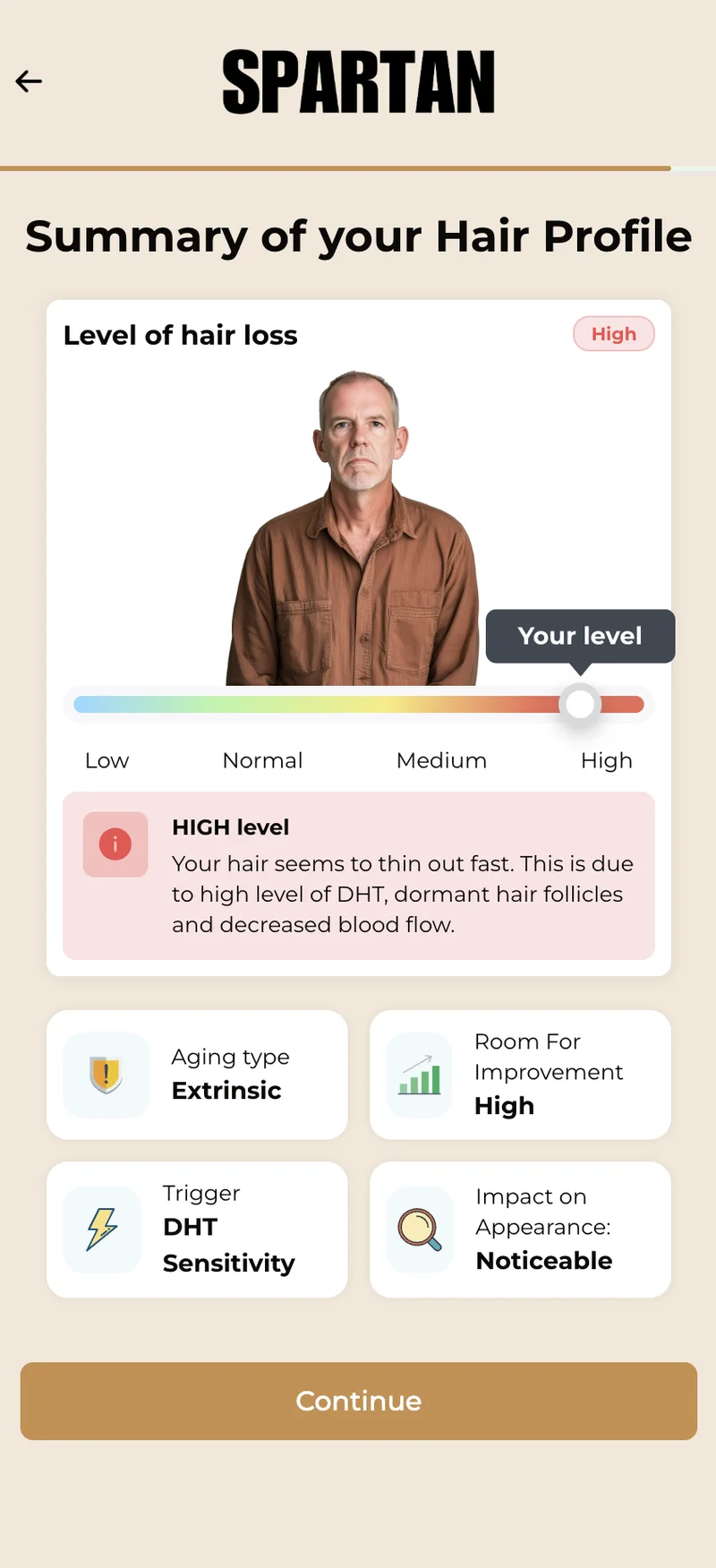
This is the funnel's centerpiece. A "Summary of your Hair Profile" card renders a personalized readout: a "Level of hair loss" gauge pinned to HIGH, a photo matched to the prospect, an explanation ("high level of DHT, dormant hair follicles and decreased blood flow"), and four diagnostic tiles — Aging type: Extrinsic, Room for improvement: High, Trigger: DHT Sensitivity, Impact on appearance: Noticeable.
Mechanically, this is the diagnosis being handed back to the prospect. It reflects the quiz answers as a clinical-looking result, which (a) feels intensely personalized, (b) confirms the problem is real and severe, and (c) names the exact mechanism — DHT, dormant follicles, blood flow — that the product claims to fix. The prospect now believes they have a diagnosed condition with a known cause. The sell is half-done.
Step 15 — Growth timeline projection (future pacing)
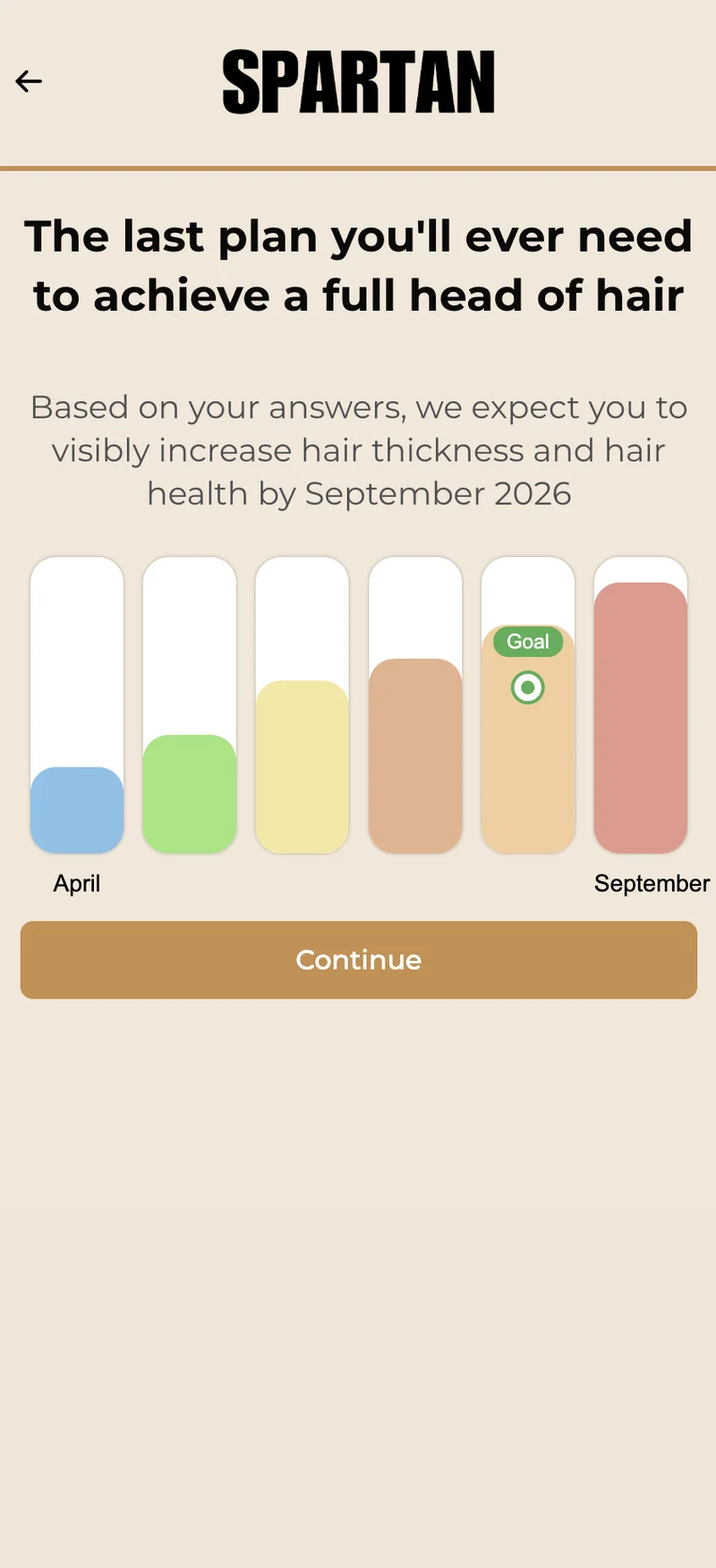
"The last plan you'll ever need to achieve a full head of hair," over a rising bar chart from the current month to a "Goal" flag a few months out — "we expect to visibly increase hair thickness and hair health by September 2026."
This is future pacing rendered as a data visualization. It makes the successful outcome feel concrete, scheduled, and inevitable — and it anchors a specific timeframe (the "as little as 10 weeks" promise) that the prospect can now visualize on a calendar. Personalized results graphs like this are one of the single highest-converting elements in DTC quiz funnels.
Step 16 — Micro-commitment pop-up (the yes-ladder close)
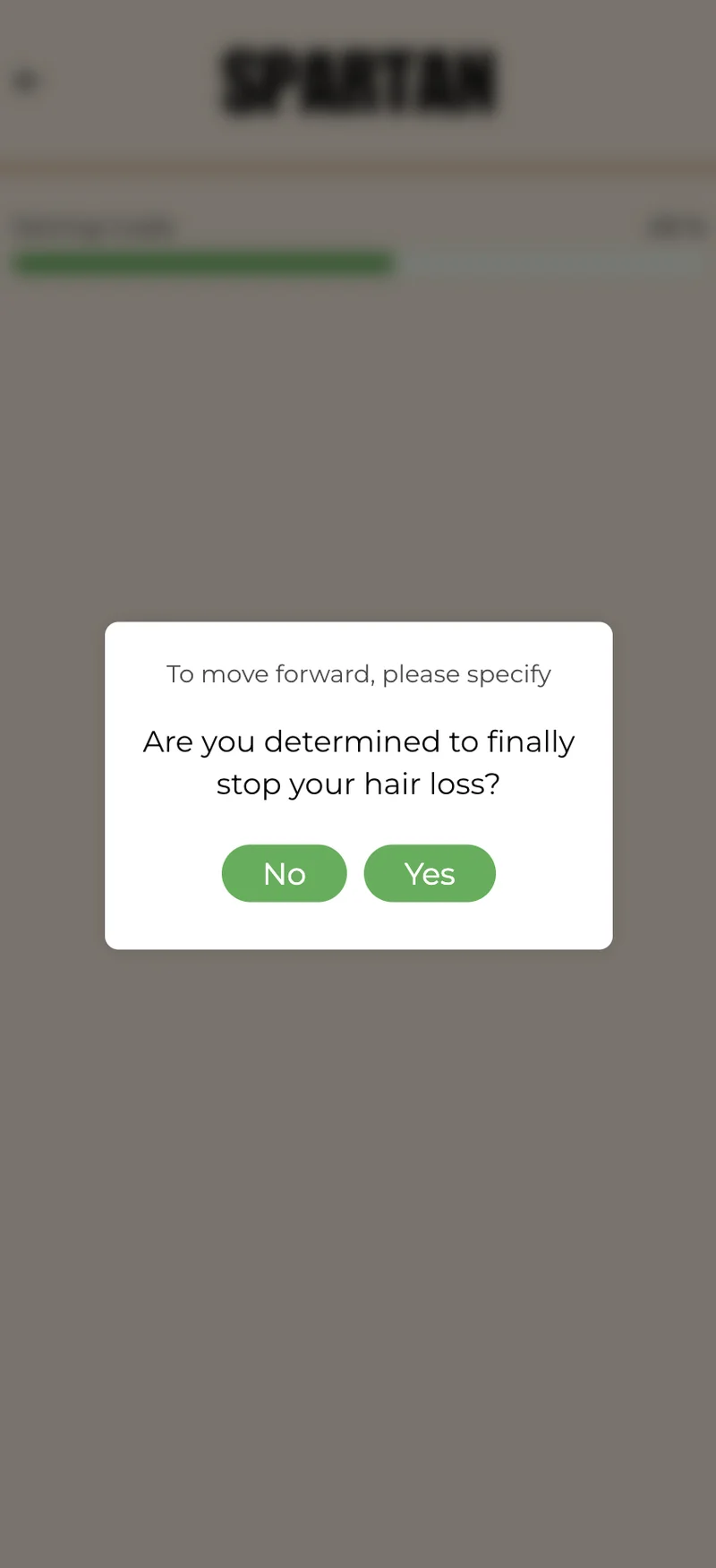
Just before the results, a modal interrupts: "Are you determined to finally stop your hair loss?" — No / Yes.
This is a classic yes-ladder micro-commitment. Tapping "Yes" is a tiny public-to-self declaration of intent that measurably increases follow-through on the offer that immediately follows. It also frames the coming sales page as the fulfillment of a commitment the prospect just made, not an interruption.
Step 17 — Plan loading screen (manufactured value)
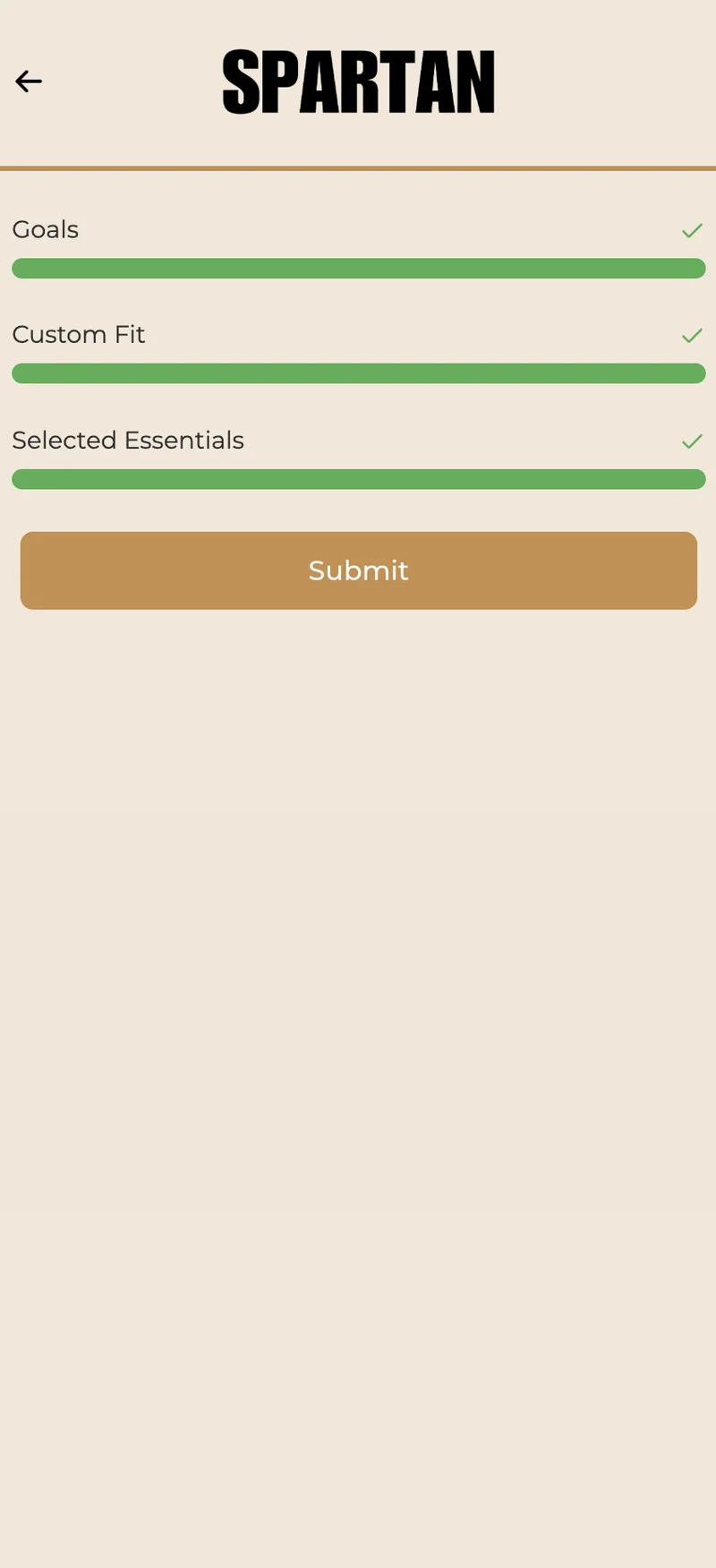
A loading/analysis screen with progressing checkmarks — Goals ✓, Custom Fit ✓, Selected Essentials ✓ — before the plan is "ready."
The loader is doing perceived-effort engineering. The artificial processing pause signals that something bespoke is being computed just for this person, which increases the perceived value (and legitimacy) of the recommendation on the next screen. It also creates a small anticipation gap right before the offer.
Step 18 — The sales page (personalized bundle offer)
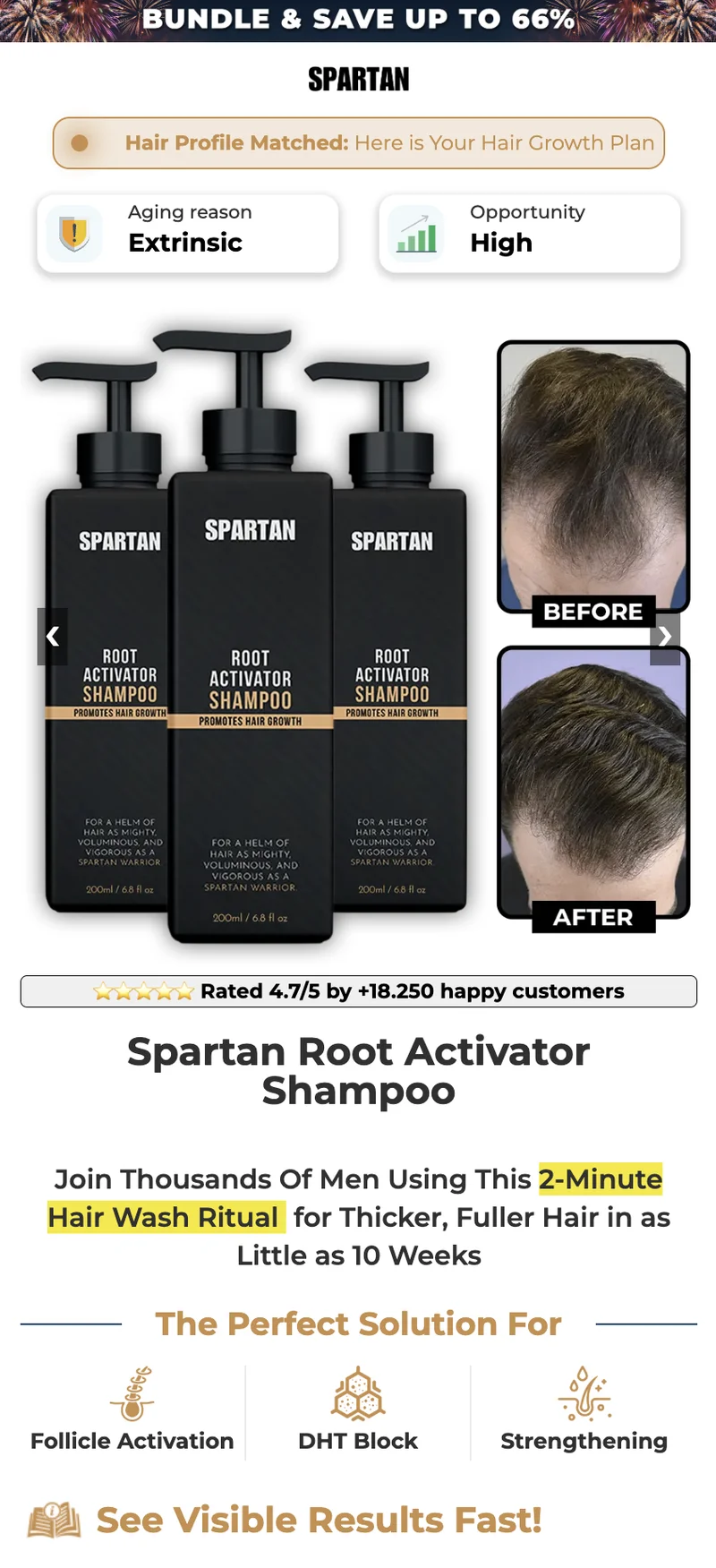
The payoff lands as a "Hair Profile Matched: Here Is Your Hair Growth Plan" page, not a generic PDP. It stacks, in order:
- A "Bundle & Save up to 66%" banner (the offer + discount anchor).
- The Aging reason / Opportunity tiles carried over from the profile — continuity that says this is your plan.
- A 3-bottle bundle shot with a before/after slider beside it.
- Rating "4.7/5 by 18,250 happy customers" — social proof at the point of decision.
- The positioning line: "a 2-minute Hair Wash Ritual for Thicker, Fuller Hair in as Little as 10 Weeks."
- Benefit icons — Follicle Activation · DHT Block · Strengthening — mapping straight back to the mechanism the quiz taught.
Every element on this page is a callback to something established earlier in the quiz. Nothing is introduced cold. That's why it converts: by the time the prospect arrives, they've self-diagnosed the problem, learned the mechanism, seen their timeline, and committed to acting. The bundle is simply the prescription for the condition they were just diagnosed with.
What's actually working — the transferable pattern
Strip away the hair-loss specifics and Spartan's funnel is a repeatable structure any DTC health/beauty brand can clone:
- Frictionless self-identifying open — age via photo tiles, first tap in under a second, no "quiz" language.
- Medical-intake framing throughout — questions read like a doctor's form, so the experience feels like diagnosis, not marketing.
- Widen the top of funnel — a "prevention" option so nobody disqualifies themselves early.
- Belief-building disguised as data — symptom questions (dandruff, stress) that quietly teach the mechanism the product fixes.
- A multi-select wish list — let prospects articulate their own desired outcomes so the offer can mirror them.
- Interstitials every 3–4 steps — social proof, before/after, motivation lines to reset attention and lift completion.
- Absolution — attribute the problem to biology (DHT, genetics) to remove shame and defensiveness.
- A named mechanism — DHT sensitivity, dormant follicles, blood flow: the "why nothing else worked and this will."
- A personalized diagnosis card — reflect the answers back as a clinical-looking result with a severity gauge.
- A future-paced results graph — a dated timeline that makes success feel scheduled and inevitable.
- A yes-ladder micro-commitment — one "Yes, I'm determined" tap right before the offer.
- A manufactured-value loading screen — perceived-effort engineering before the reveal.
- A callback-stacked offer — a sales page where every element references something the quiz already established.
The takeaway for hair-loss DTC brands
The "best" quiz funnel for a hair-loss brand isn't the one with the most steps or the slickest design. It's the one that turns the prospect into their own diagnostician — so the product arrives as the answer to a question they asked, in a category where being sold to triggers instant skepticism. Spartan nails it: 18 steps of intake, mechanism, and personalized proof, ending on an offer that feels inevitable.
You don't need to reinvent this. You need to rebuild it for your product's mechanism and your avatar's specific wound. That's exactly what a quiz-funnel builder like ClarFlow is for — the diagnostic-to-prescription structure above is a template you can assemble in an afternoon, then point your Meta ads at.