IM8 Breakdown
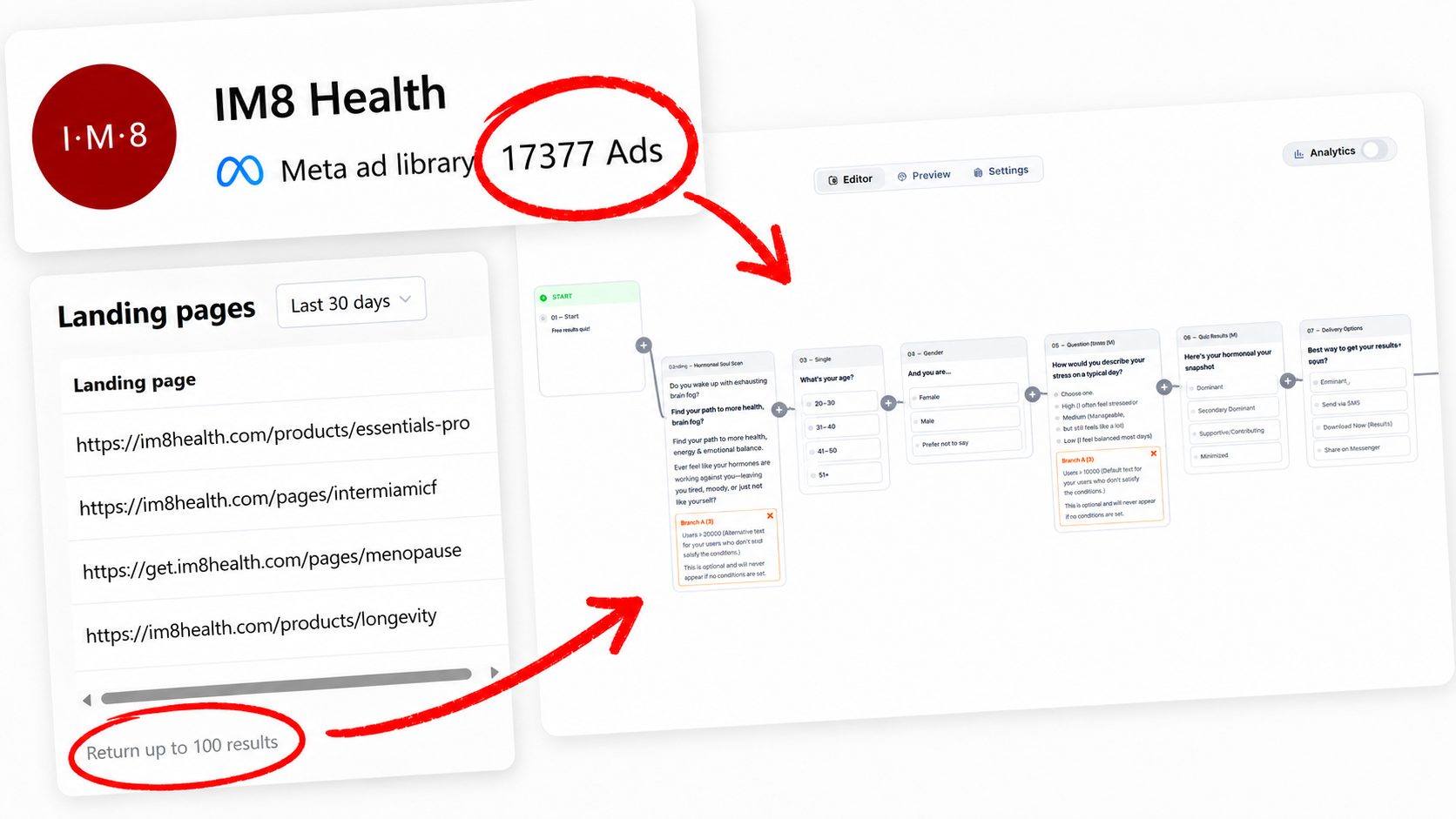
IM8’s current numbers are ridiculous:
- 17,377 ads
- Hundreds of landing pages
- An absurd volume of new angles, formats, and creatives being pushed every single week
At that scale, the quiz can’t feel like some random Chat GPT slop.
It has to preserve the brand experience while still converting aggressively.
So here’s the quiz funnel we built for them:
First, the #1 question you should ask before building any quiz is:
“Is this congruent with the traffic I’m sending to it?”
Because a quiz never exists in a vacuum.
It has to match the messaging, mechanism, proof, emotions, and level of awareness that made someone click into it in the first place.
In IM8’s case, they were running multiple ads using GLP-1 side effects as the core angle:
- Fatigue
- Brain fog
- Hair shedding
- Weakness
- Poor sleep
Which showed us they were catering towards a problem-aware audience.
People who knew something felt off after starting on a GLP-1…
But didn’t fully understand the mechanism behind it yet.
So instead of making the quiz feel like a generic “wellness assessment” that pushed the solution right away…
It had to feel like a diagnostic tool that explained the hidden nutritional cost behind the symptoms they were already experiencing - just like the ads did.
That’s why the main angle became:
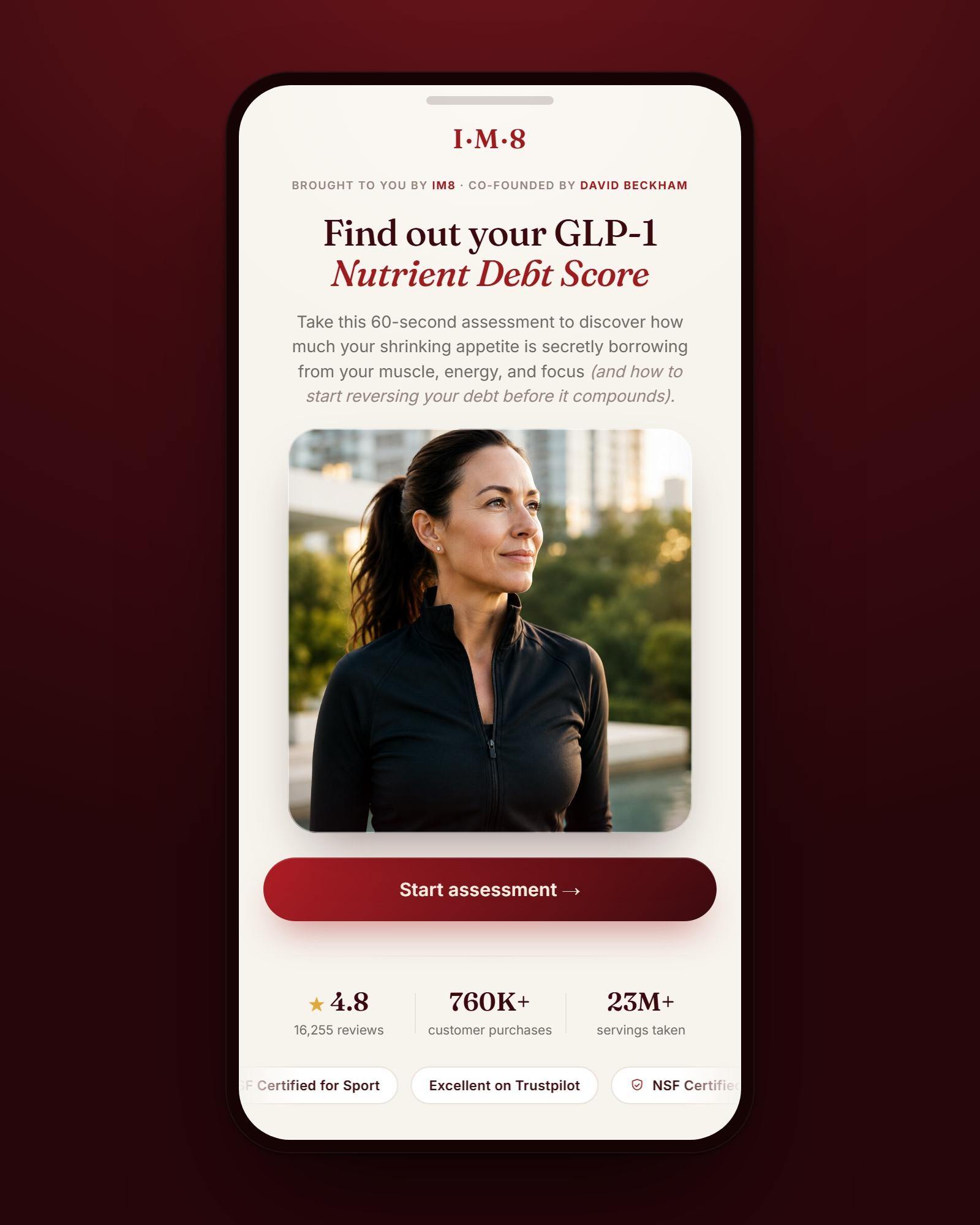
“Find out your GLP-1 Nutrient Debt Score”
The phrase “nutrient debt” does a lot of work.
It presupposes that even though GLP-1 is helping you eat less…
It’s also quietly creating a bill your body has to pay somewhere else.
And that “somewhere else” ties directly into the symptoms they’ve already seen in the ads:
Energy.
Muscle.
Focus.
Hair.
Sleep.
Then we built the funnel around a few key principles:
- Authority before product
In this case, the first screen doesn’t start by asking for age or gender.
Because with V1s, the goal is to collect enough data as quickly as possible — and the fastest way to do that is by removing as much friction as we can.
Think of it like eating the first potato chip.
The goal is to make the first bite so frictionless that eating the whole bag feels natural.
So instead of asking them to give us information upfront, we use the first slide to give them reasons to keep going.
It gently establishes the problem, positions the quiz as the path to relief, and gives them the easiest possible action:
Just click “Start.”
All while giving ourselves room to nuke skepticism by stacking all the authority assets that makes IM8 different:
- Positive desire before negative admission
Instead of starting with:
“What’s wrong with you?”
We ask:
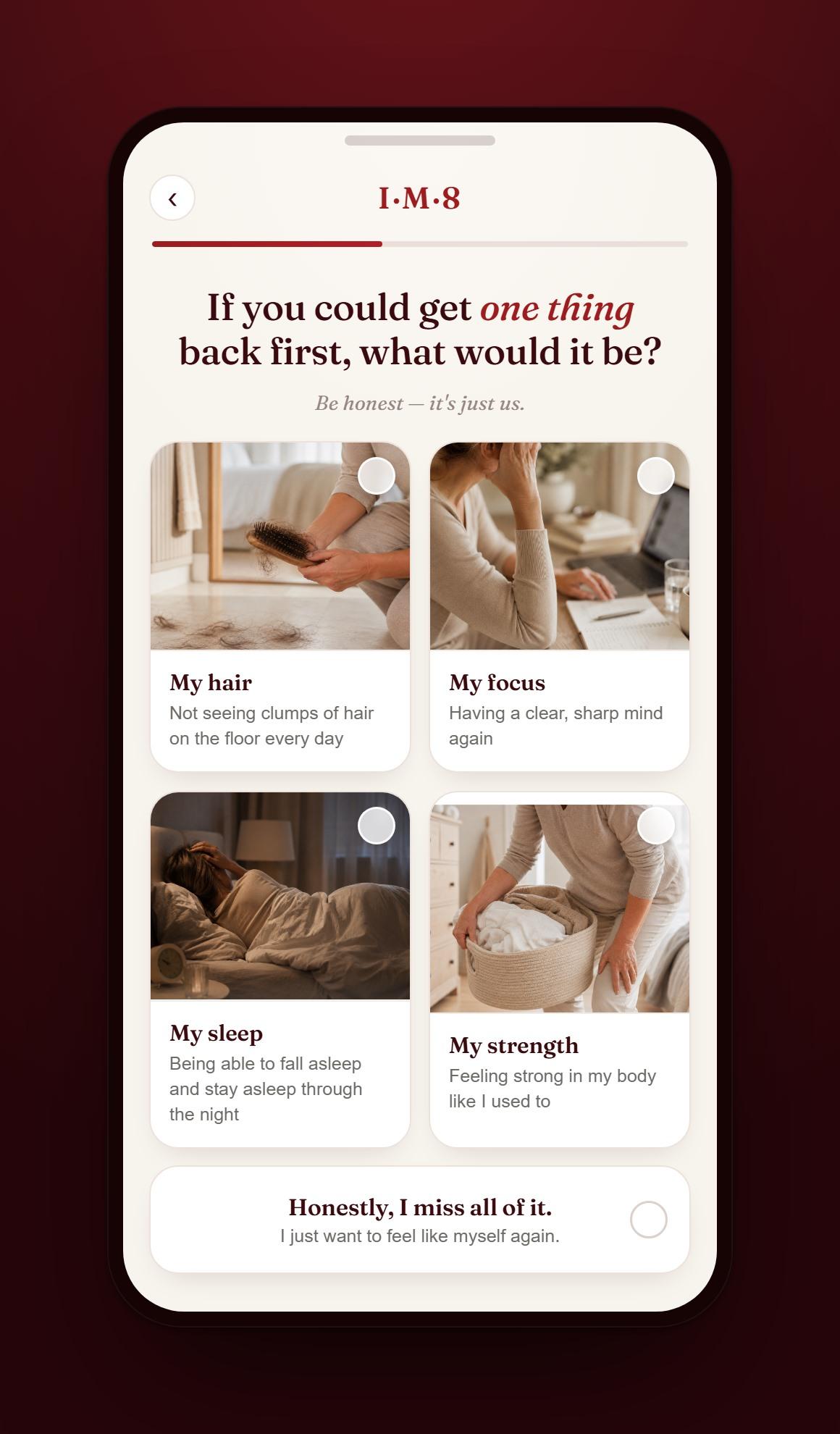
“If you could get one thing back first, what would it be?”
One question makes people feel like they’re admitting a problem.
The other also acknowledges their problem - but points their attention toward the outcome they want.
One creates shame, resistance, and self-protection…which tends to pull them out and increase drop-offs.
The other creates hope, motivation, and emotional momentum…which tends to pull them deeper in, increasing stick rate.
So instead of forcing them to say:
“I’m tired, foggy, weak, and my hair is falling out.”
We let them future pace themselves by saying:
“I want my energy back.”
“I want my focus back.”
“I want my sleep back.”
“I want to feel strong again.”
“I want to feel like myself again.”
With this framing, they admit the problem through nostalgia, not shame.
They’re not saying:
“I’m broken.”
They’re saying:
“I miss feeling like myself - and I want to be whole again”
And that’s a much easier emotional doorway to walk through, especially at the beginning of the quiz when they’re not fully invested yet.
- Answers that presuppose the problem
Persuasion is a game of intensity.
You can’t sell the relief before they’ve fully felt the weight.
Because if you keep switching between pain and payoff too soon, both get diluted.
The pain starts to feel tolerable.
And the payoff becomes optional.
That’s why direct response is often associated with “twisting the knife.”
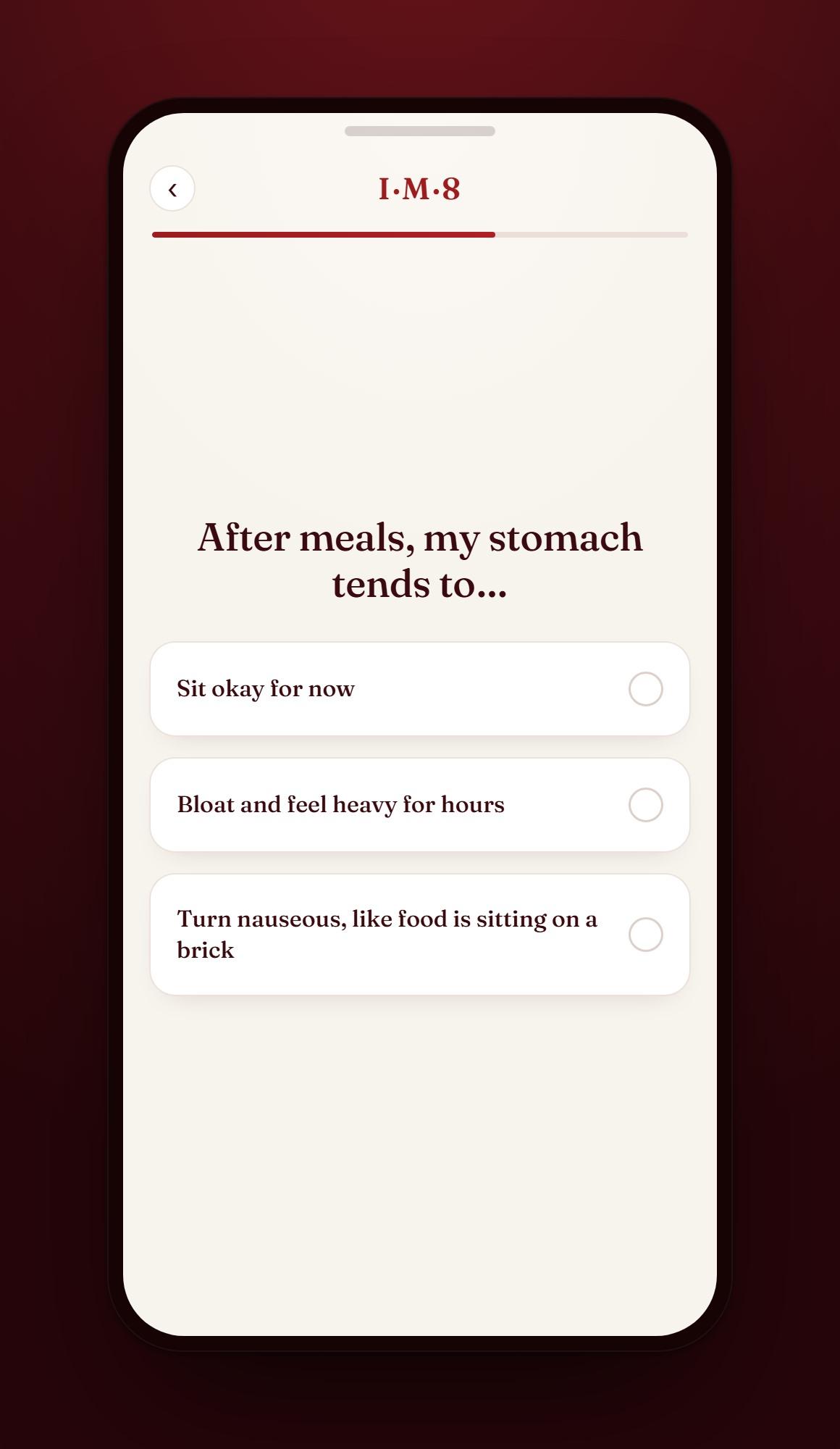
So while we’re leading someone through the diagnostic part of the quiz, every answer needs to carry some level of problem-state momentum.
We don’t want to give them an answer that lets them mentally opt out of the problem.
Meaning instead of:
“My stomach is fine”
The best-case answer becomes:
“I haven’t had any issues yet”
That “yet” matters, because it implies they’re fine FOR NOW - which keeps the problem-state momentum alive.
It doesn’t force over-admission…
But it also doesn’t let the user completely escape the emotional state the quiz has been building.
Because if the user exits the problem too early, the solution loses urgency.
- Comfort before the offer
After going through a series of questions that made them think about their symptoms, frustrations, and everything that has been wrong with their life…the prospect’s stress levels are at its peak.
And when people feel stressed, panicked or overwhelmed, they instinctively freeze.
Meaning they get defensive, avoid making decisions and pull away from commitment.
We don’t want that.
That’s why, before transitioning into the offer, we need to lower the emotional pressure by giving them a sense of relief.
And that’s where comfort language comes in.
Comfort language is all about making the user feel like they’re not alone and that it’s not their fault.
It validates what they’re feeling.
It removes shame.
It lowers defensiveness.
And it opens them up to actually doing something about the problem.
So when the offer comes in, it doesn’t feel like:
“You need to buy this to get out of the pit.”
It feels like:
“This is the next natural step for someone in your situation”
Which naturally makes them much more open to buying.
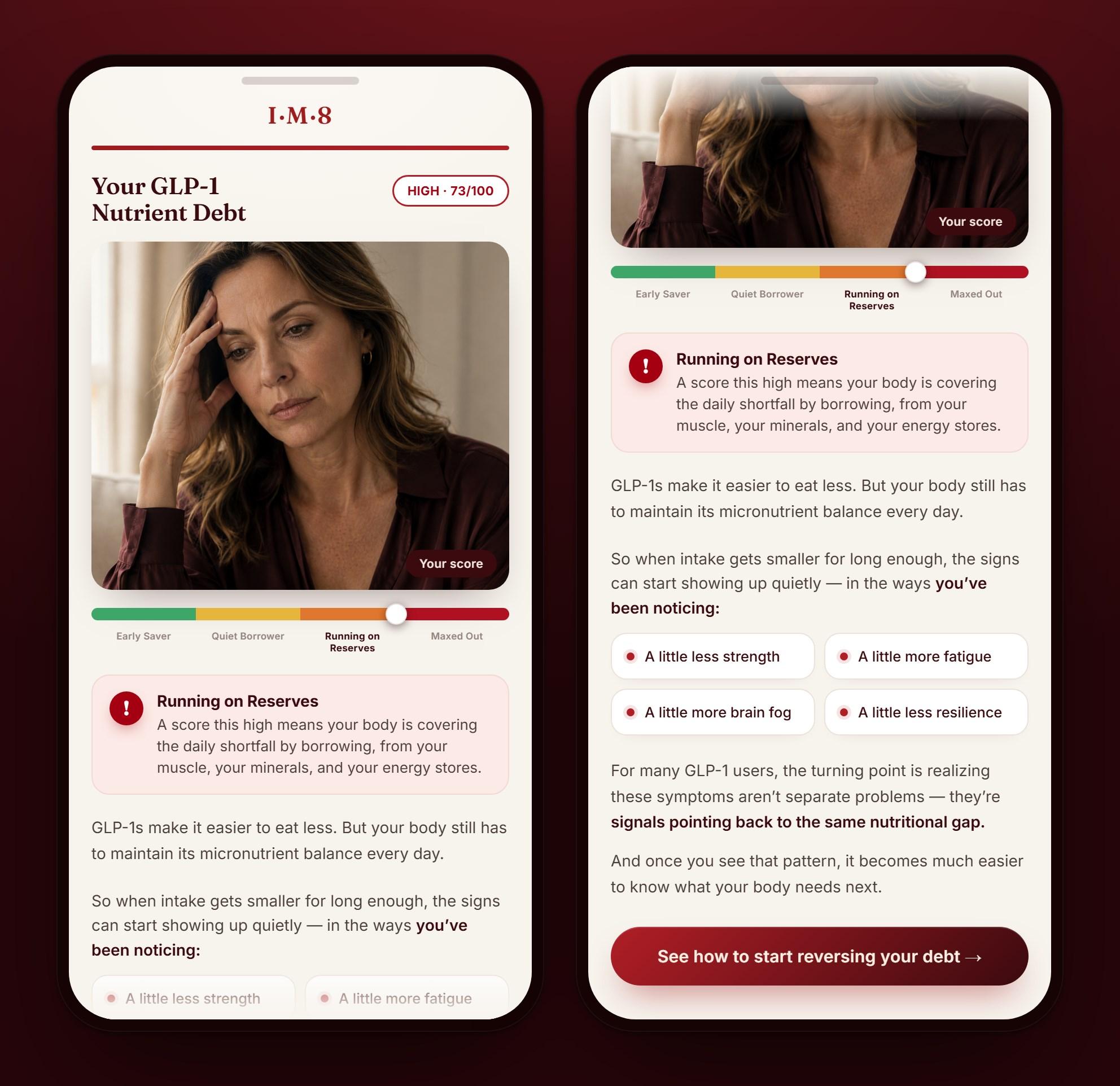
If you look closely, the quiz still uses proven direct-response fundamentals to drive conversions:
- Curiosity gap
- Self-diagnosis
- Problem intensification
- Authority stacking
- Personalized reveal
But visually and tonally, it still feels like IM8.
Clean.
Premium.
Clinical.
Credible.
Not some cheap AI slop.
Because yes, thanks to AI, anybody can spin up a quiz funnel in minutes now.
But the real bangers come when you understand why it works, how to structure it around your creatives, and how to make it feel native to the brand behind it.
That’s what we’ve learned from building hundreds of quiz funnels for some of the biggest DTC brands out there.
And if you’re already doing 100k/mo or more with your DTC brand and want us to build yours…
Comment “QUIZ” and I’ll send you the details.