
Most "quiz builders" weren't built for DTC.
They were built for course creators. For lead-gen marketers. For HR onboarding. For BuzzFeed-style personality quizzes that tell you which Hogwarts house you belong to. Then somebody at the company woke up one morning, noticed Shopify brands were paying for software, and bolted on a "product recommendation" template.
That's why most ecommerce quizzes feel like glorified survey forms. The tools weren't designed around the psychology of selling — they were designed around branching logic and email capture, then dressed up for an audience the original PM never had in mind.
We built ClarFlow because none of those tools could ship the quiz funnels we actually wanted to run. Not in a Friday afternoon. Not without writing custom code. Not without hacking the UI to do things it was never designed for.
This article is the case for why ClarFlow is the best quiz funnel software for ecommerce, and what the tool actually does that nothing else in the category does. We're going to skip the false-balance "objective comparison" routine because frankly that's not what you came here for. You came here to figure out whether ClarFlow is right for your brand. Let's get into it.
The 7 things ecommerce actually needs from a quiz tool
Before we talk about ClarFlow, here's the rubric we built the product against. If your quiz tool can't do these seven things at a high level, it's not really a quiz funnel builder for ecommerce — it's a survey tool with delusions.
1. Native psychology blocks, not just questions. Statement barrages. Mid-quiz interstitial reframes. Three-card closing sequences. Fake AI loading screens. Pseudo-diagnosis result pages. Scratch-to-reveal offers. The mechanism shift screen. If your builder forces you to fight the UI to add an interstitial, the platform isn't built for DTC — it's built for surveys.
2. Branching logic that doesn't suck. Conditional routing on every previous answer. Cumulative scoring. Skip logic. Personalized paths. This is table stakes. Every tool claims it. Almost none execute it without making you want to throw your laptop.
3. Dynamic, personalized result pages. The result page is the close. It needs to dynamically reference the user's answers, recommend specific products from your catalog, and feel earned. Static "Here are your top 3 results!" pages waste the entire quiz.
4. Zero-party data piped to Klaviyo and Meta CAPI as a first-class feature. Every quiz answer needs to flow into Klaviyo as a profile property AND into Meta CAPI as a custom audience. If your quiz tool collects the data and then nothing happens with it downstream, you're collecting trophies, not running a funnel.
5. Native ecommerce integrations. Shopify product sync. Dynamic product blocks. Real-time inventory awareness. Discount code generation. Brands shouldn't have to Zapier their way into basic sales mechanics in 2026.
6. Speed and mobile UX. Cold paid traffic is 90% mobile. If your quiz takes 3 seconds to load on a 4G connection, half your funnel bounces before question one. Lightweight, instant, native mobile feel — non-negotiable.
7. Pricing that doesn't punish you for scaling. Some tools price per quiz response. The wrong pricing model can quietly murder your unit economics once you start scaling Meta spend. The math has to keep working at $100K/month and $500K/month and $1M/month in ad spend.
That's the rubric. Now here's what nobody else in the category does.
Why ClarFlow is built different
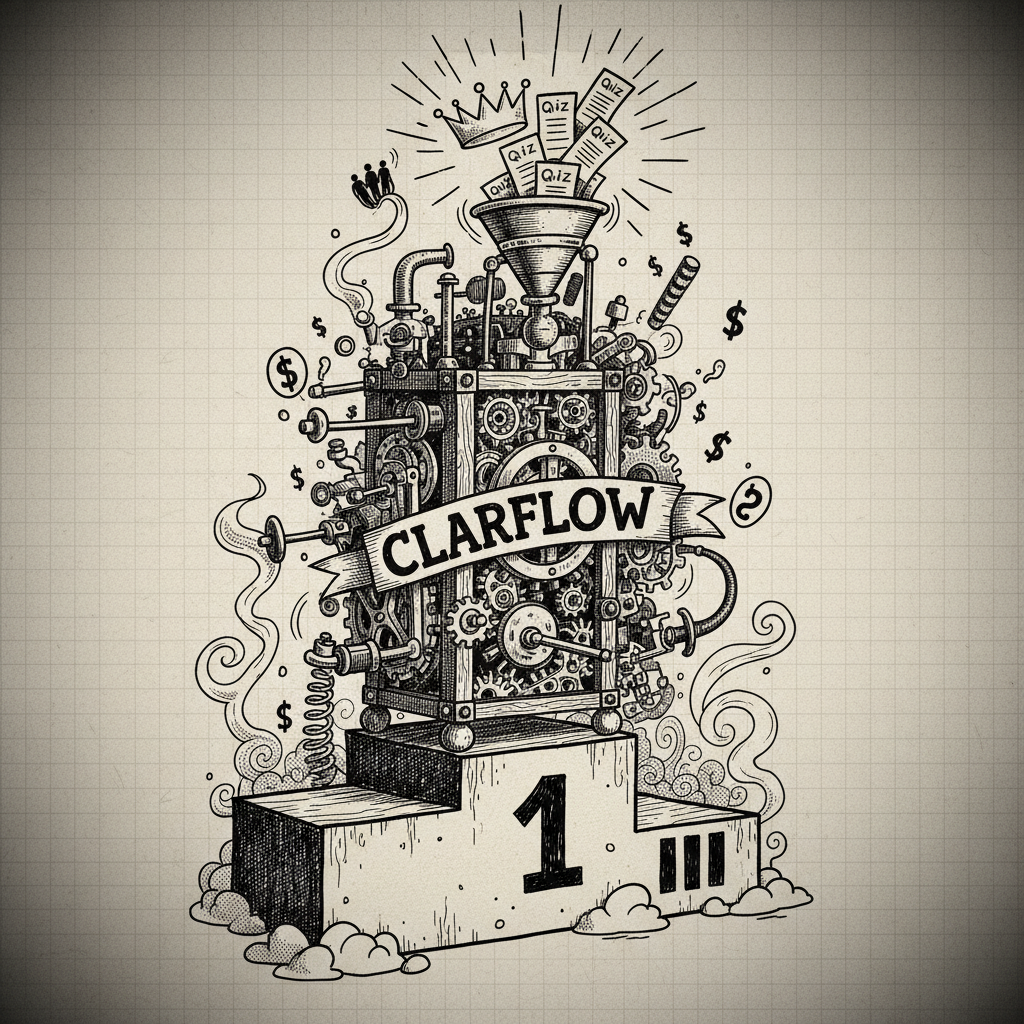
ClarFlow is the only quiz funnel builder designed from the ground up for DTC sales psychology.
Not as a survey tool that pivoted into ecommerce. Not as a lead-gen tool that bolted on a Shopify integration. Not as an enterprise platform that priced itself out of reach for the brands actually shipping cold paid traffic. We built ClarFlow because the existing quiz tools couldn't handle the plays the best DTC brands were actually running on the highest-converting funnels in the market — and we wanted to make those plays one-click instead of three-week-engineering-sprint.
Here's what's different.
1. Every DTC psychology block is native
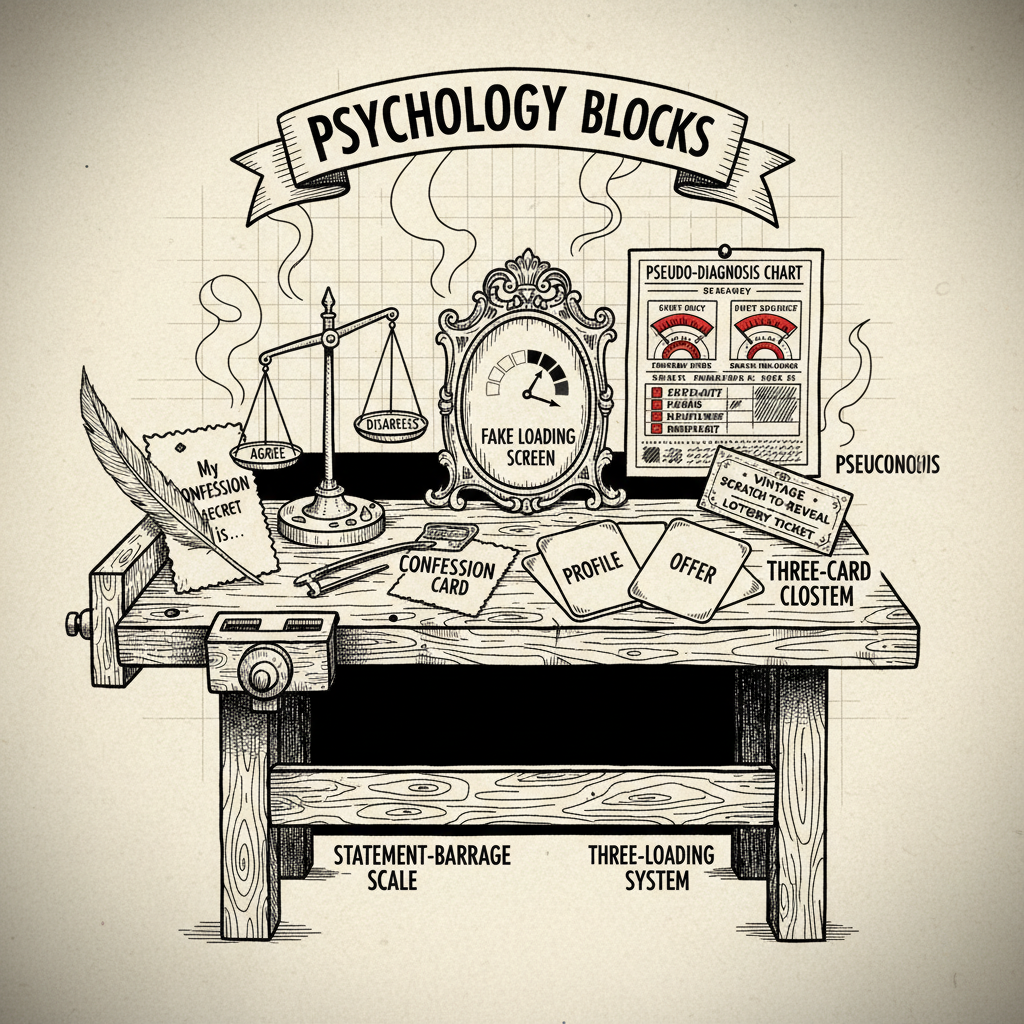
Every move in the modern DTC playbook is a pre-built block inside ClarFlow. Not a template you have to assemble from scratch. Not a hack with custom CSS. A native block. Drag, drop, configure, ship.
The Confession-Then-Reframe Sequence (Hike Footwear). A sequence of confession questions ("What have you tried? Why didn't it work?") followed by a mid-quiz interstitial that reframes the cause of the failure ("Most comfortable shoes are weakening your feet"). The highest-leverage screen in the entire funnel — and it's a one-click block in ClarFlow.
The Statement Barrage (Liven, Kilo Health). Replace 10 questions with 10 agree-scale statements. "I often feel overwhelmed." Strongly Agree. Each agreement is a micro-commitment. By the 15th statement, the customer has built a complete internal case that they have the problem your product solves — and they built it themselves. Native block.
The Three-Card Closing System (Mars Men). After the last question, drop three sequential cards: Profile (your diagnosis) → Future Pace (where you could be) → Offer (the prescription). It mirrors a doctor's visit exactly. Mars Men runs nine figures a year on this close. Native block.
The Fake AI Loading Screen. "Analyzing your symptoms... matching against 247,000 responses..." 8-12 seconds of progress bars and rotating status messages while the result was deterministic from question three. The loading screen isn't a UX delay — it's a conversion asset that triples perceived personalization. Native block.
The Pseudo-Diagnosis Result Page. Clinical-style severity gauges. Red/yellow/green scoring. "Impact areas" lists. The result that looks like a diagnosis from a medical portal, not a quiz score. Native block.
The Scratch-to-Reveal Offer. Tactile, gamified, irresistible to click. The discount feels earned because the customer physically uncovered it. Native block.
The Mechanism Reframe Interstitial. One full-screen slide that shifts the customer's belief about what their problem actually is. "It's not your skin. It's your water." / "It's not compression. It's the material." / "It's not your feet. It's your shoes." Drop it after the confession sequence and let the rest of the funnel write itself. Native block.
In every other quiz builder on the market, you have to engineer these from scratch — and most teams give up halfway through and ship a multiple-choice quiz that converts at 1.8% instead of 4.5%. In ClarFlow, you fork them from a template and customize the copy.
That's the difference between a survey tool and a quiz funnel software for ecommerce. The blocks ARE the product.
2. Result pages personalize themselves
The result page is the close. It's where the quiz earns its keep. And in most quiz builders, the result page is an afterthought — a static block that says "Based on your answers, here are your top 3 products!" with no real connection to what the customer actually told you.
ClarFlow's result page is dynamic by default. Every answer the customer gave becomes a variable you can reference anywhere on the page — in the headline, the diagnosis paragraph, the recommended product blocks, the symptom callouts, the testimonials. You can pull the customer's name, their stated problem, their priority goal, their stated past failures, and their projected outcome — all into one personalized result page that feels like it was written for them specifically.
You can also pipe the answers into an LLM at runtime to generate the headline and the diagnosis copy on the fly. Not merge tags — actual generated paragraphs that read the customer's specific cluster of answers and write a tailored response. This is the difference between "Your result: Energy Booster Bundle" and "Sarah, based on your answers, you're dealing with an afternoon cortisol cascade — here's what's happening in your body and what you can do about it..."
The first result page converts at the same rate as the product page. The second one converts 30-50% higher. That's the gap a personalized result page closes — and it's table stakes inside ClarFlow.
3. Zero-party data flows to Klaviyo and Meta CAPI natively
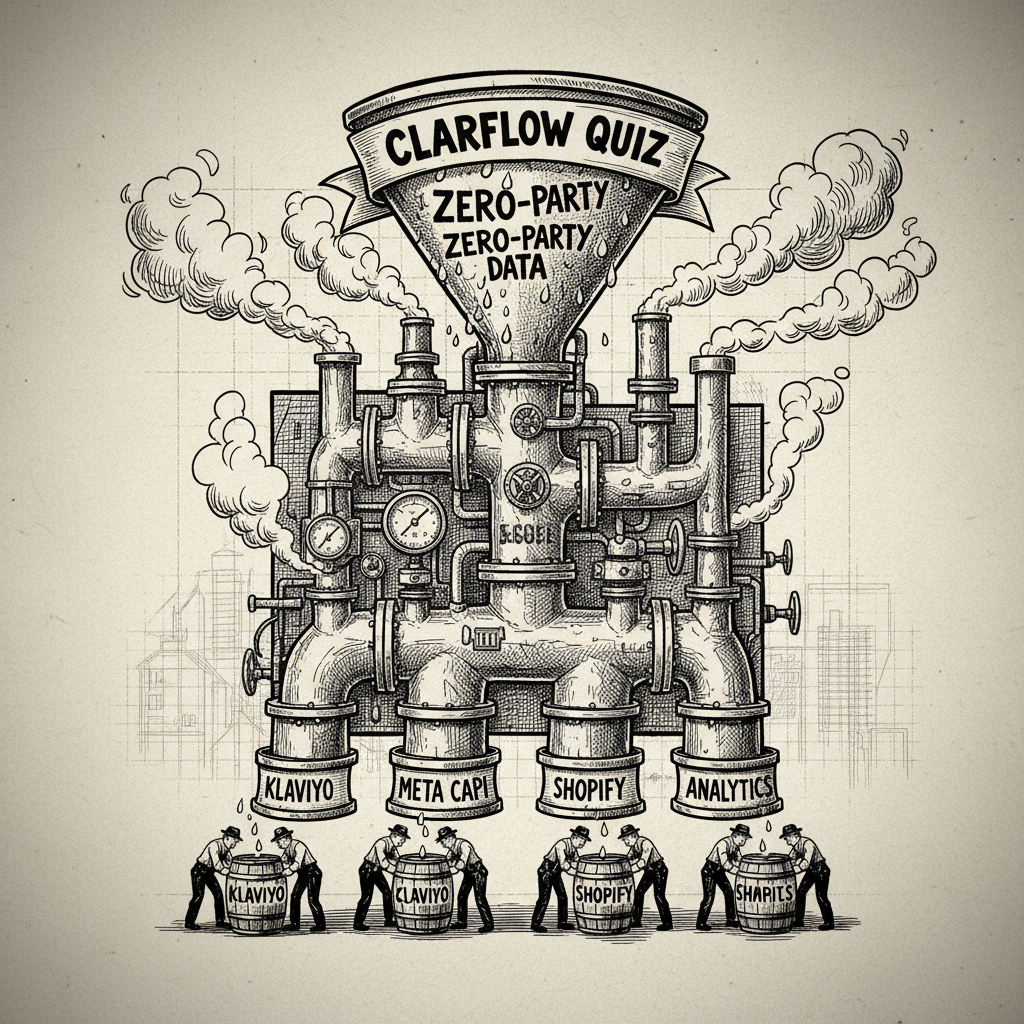
The quiz captures data. The data is the asset. If the data doesn't flow into your retargeting and email stack, you've built an expensive trophy.
Every quiz answer in ClarFlow becomes:
- A profile property in Klaviyo — automatic. No Zapier. No webhook engineering. The customer says they've tried supplements before? That's a property on their profile. Now your Klaviyo welcome flow can branch on it.
- A custom audience in Meta CAPI — automatic. The customer says their main issue is sleep? They land in a "sleep" audience that you can target with sleep-angle creative.
- A segment for retargeting — anywhere. The same data flows to Google Ads, TikTok, Klaviyo SMS, and your analytics stack.
This is the move. Your competitors are running generic Meta retargeting against "visited product page." You're running answer-matched retargeting against "said sleep is their biggest issue, said they've tried melatonin and it didn't work." Same product. Different angle. Matched to what the customer literally told you.
That's the arbitrage compounding across months of ad spend. And it only exists if your quiz tool pipes the data downstream as a first-class feature, not as a "premium integration" you pay extra for.
4. The full funnel canvas, not just the quiz
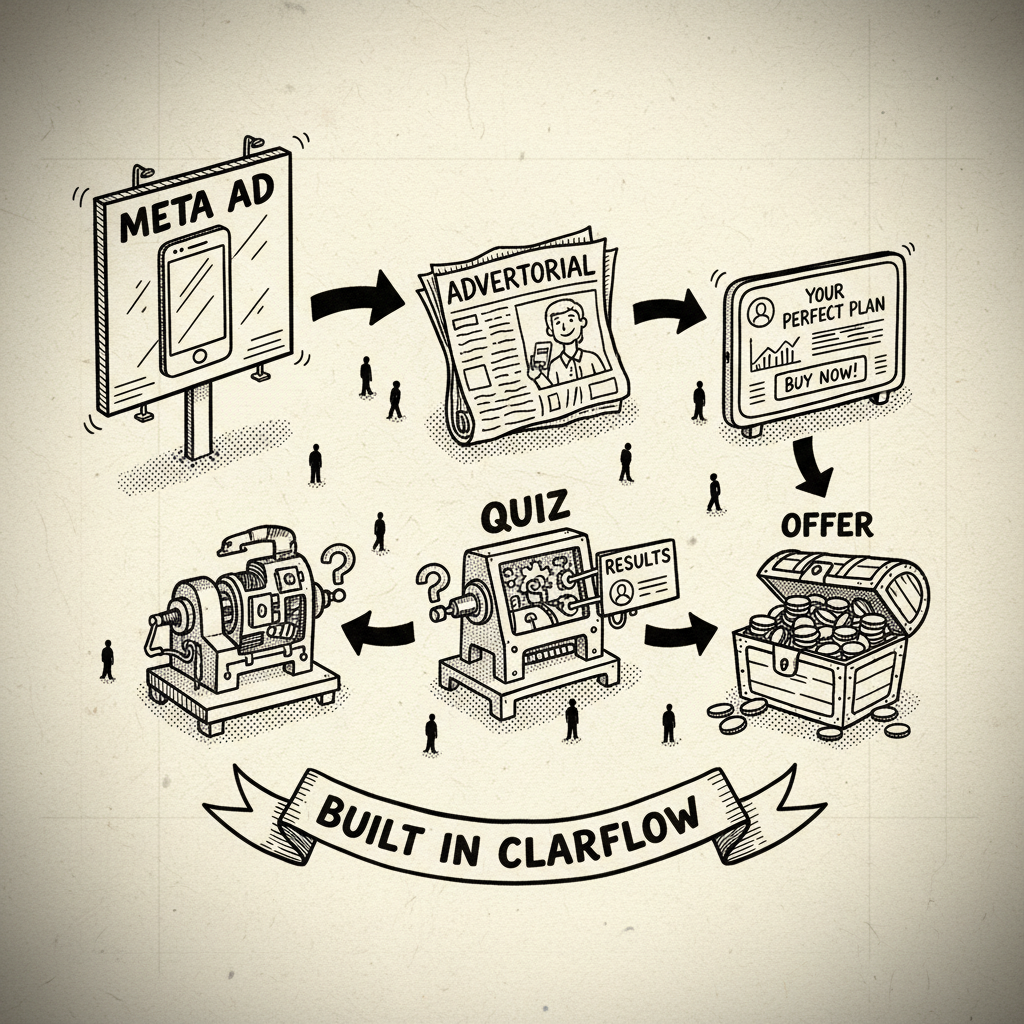
Most quiz tools give you the quiz layer and stop there. You build the quiz, then you bounce the customer back to your Shopify store and pray the existing PDP can close them.
ClarFlow gives you the entire funnel canvas. Inside one builder you can ship:
- Advertorial pages — long-form editorial-style landing pages with the villain reframe baked in
- Listicle pages — "10 Reasons Why..." numbered-list pages with the comparison anchor at the top
- Quiz funnels — the full psychology block library
- Personalized result pages — dynamic per user, with LLM-generated copy if you want it
- Offer pages — with countdown timers, scarcity blocks, dynamic discount codes, and one-click checkout
- Post-purchase upsells — to lift AOV after the first conversion fires
The architecture that scales — Ad → Advertorial → Quiz → Result → Offer — is one canvas in ClarFlow. Not five separate tools wired together with Zapier. The whole funnel lives in one place.
That's a different category of product from "quiz builder." It's a funnel canvas that happens to have the best quiz module on the market.
5. Mobile-first, instant-load
90% of cold paid traffic is mobile. If your quiz funnel takes 3 seconds to load on a 4G connection, half your audience bounces before they see question one. The funnel dies at the door, and you blame the creative.
ClarFlow funnels load in under a second on mobile. The pages are built mobile-first, the assets are aggressively optimized, and the canvas renders client-side after the initial paint. We obsess about this because every 100ms of latency costs you completion rate, and completion rate is the math that decides whether the funnel makes money or burns it.
This isn't a feature. It's a non-negotiable. We won't ship a UI block that breaks the speed budget.
6. Pricing that doesn't punish you for scaling
Some quiz tools charge per response. That model collapses the moment you try to scale Meta spend, because the cost of the quiz tool grows linearly with the success of the funnel.
ClarFlow's pricing is built around the math of paid acquisition. The starter tier is free. Paid plans scale on features and team seats, not on response volume. You can run the same quiz to 10,000 visitors or 1,000,000 visitors and the bill doesn't quietly murder your unit economics.
We price this way on purpose because we're building for brands who actually intend to scale paid traffic. If your quiz tool's pricing model stops working at $100K/month in ad spend, you're going to switch tools at $100K/month — and we'd rather you not have to switch.
The DTC plays you can ship in ClarFlow this week
These are the funnel patterns the best DTC brands are running right now. Each one is a pre-built template inside ClarFlow. Fork it, swap the copy, ship it.
The Doctor's Diagnosis Quiz (Happy Mammoth pattern). A symptom assessment quiz that runs the doctor question framework, captures hyper-specific pain points, and delivers a personalized "diagnosis" that ties to your product. Best for: supplements, hormone health, skincare, sleep, energy.
The Confession-Then-Reframe (Hike Footwear pattern). Confession questions about what the customer has tried, followed by a mid-quiz mechanism reframe that reframes the cause of every prior failure. Best for: any category where the customer has tried alternatives that didn't work.
The Statement Barrage (Liven pattern). 10-15 agree-scale statements in a row that force the customer to self-diagnose without you telling them anything. Best for: shame-driven categories — overthinking, mental wellness, weight, ED, sleep.
The Three-Card Close (Mars Men pattern). A profile card → future-pace card → offer card sequence at the end of the quiz that mirrors a doctor's prescription. Best for: high-AOV men's health, supplements, transformation offers.
The Custom Formulation Quiz (Function of Beauty pattern). Quiz answers map to a literally bespoke product variant with the customer's name, color, or formula on it. Best for: beauty, skincare, custom-formulation brands.
The Style Finder (Warby Parker pattern). Quiz qualifies the customer into a try-before-you-buy program — sample pack, home try-on, consultation. Best for: apparel, eyewear, accessories, anything where the customer wants to try before committing.
The Listicle + Quiz Hybrid (Hollow Sox / Drivse pattern). Listicle landing page → quiz funnel → personalized offer. The listicle does the cold-traffic work; the quiz does the qualification and close. Best for: mature categories with strong proof — compression, supplements, water filtration, footwear.
Every one of these is a fork-and-customize template inside ClarFlow. You're not building from scratch. You're stealing the architecture of brands that already won and adapting it to your offer.
That's why ClarFlow exists.
What ClarFlow is NOT for
We're not going to pretend the tool fits every use case. Here's where ClarFlow is the wrong call.
HR onboarding quizzes. ClarFlow is overkill, and the psychology blocks aren't relevant. Use Typeform.
BuzzFeed-style personality quizzes. If you're building a "Which Disney princess are you?" quiz to drive blog traffic, ClarFlow is overbuilt for the use case. Use Interact.
B2B lead qualification forms. ClarFlow can technically do this, but the product is opinionated toward DTC sales psychology. If your funnel ends in a "Book a Demo" button instead of a checkout, the DTC psychology blocks don't earn their keep. Use a B2B-native tool.
Pure customer feedback surveys. Use Typeform or SurveyMonkey. The tools are built for that and ClarFlow isn't.
Enterprise CPG with a 6-figure annual procurement process. If you need SOC 2 Type II, custom MSAs, dedicated CSMs, and a 12-week implementation timeline, you're shopping at Jebbit's price point. ClarFlow is self-serve and ships in hours, not quarters.
If you fit any of those, we're not the right tool. We'd rather tell you that than charge you for a product you'll outgrow or fight.
If you're a DTC brand on Shopify (or anywhere else) running cold paid traffic into quiz funnels, ClarFlow is the best quiz funnel software for ecommerce for one reason: every block in the modern DTC playbook is native, the data flows downstream natively, the result pages personalize themselves natively, and the pricing doesn't punish you for scaling.
That's the entire pitch.
Pricing
ClarFlow's pricing is structured to stay viable from your first $0 of ad spend through your first $1M+ month.
Free — Build and publish quiz funnels with no quiz response limit. Use the full block library. Test the product end-to-end before paying anything. Most DTC brands building their first funnel start here.
Pro — For brands actively running paid traffic. Unlocks the LLM-driven dynamic result pages, advanced Klaviyo and Meta CAPI integrations, custom domains, A/B testing, and team collaboration features. Priced as a flat monthly subscription, not per-response.
Scale — For brands running $100K+/month in ad spend. Adds priority support, advanced analytics, custom integration consulting, and the templates from our highest-converting Funnel Teardowns library.
The pricing model is designed to never penalize you for shipping a winning funnel. The more your quiz scales, the more value you get — not the bigger your bill gets.
Full pricing details: clarflow.com/pricing
How to get started
The fastest path to a winning quiz funnel:
-
Start with a template. Don't invent the architecture from scratch. Fork one of the proven funnels in the Funnel Teardowns library — every template is based on a real DTC quiz that's actually printing money.
-
Customize the copy, not the structure. The architecture is the win. The copy is the variable. Swap the questions, the brand voice, the products — but don't redesign the flow until you've shipped at least one version to cold traffic.
-
Ship to a small audience first. $200 of Meta spend is enough to know if the funnel is alive. Don't optimize for three weeks before you've put real cold traffic on it.
-
Read the quiz answers, not just the conversion rate. The data the quiz collects is more valuable than the sale itself for the first month. It tells you what to write next, what to A/B test, and what your retargeting copy should say.
-
Plug into Klaviyo and Meta CAPI on day one. Don't wait until you "have time." The retargeting and email lift compounds from the very first lead.
The whole loop — fork, customize, ship, learn — runs in a week. Not a quarter. Not a six-month engineering project. A week.
Build your first quiz funnel for free
If you've made it this far, you already know whether ClarFlow is the right tool for what you're building. We're the best quiz funnel software for ecommerce if your job is to ship cold paid traffic into quiz funnels that actually convert — and we're the wrong tool if your job is something else. We'd rather be honest about both.
Every block in the modern DTC playbook is native. The data flows downstream natively. The result pages personalize themselves natively. The pricing doesn't punish you for scaling. The templates are forks of funnels that already won.
You can build your first quiz funnel for free, ship it to cold traffic, and see if the math changes. That's the offer.
Start building your quiz funnel for free →
Or if you want to see what a winning quiz funnel actually looks like before you build, the Funnel Teardowns library has the question-by-question breakdowns of the highest-converting DTC quizzes in the market right now.
The window for the quiz funnel arbitrage is still open. Most of your competitors are still firing cold traffic at product pages. Pick the right tool and go take their lunch.