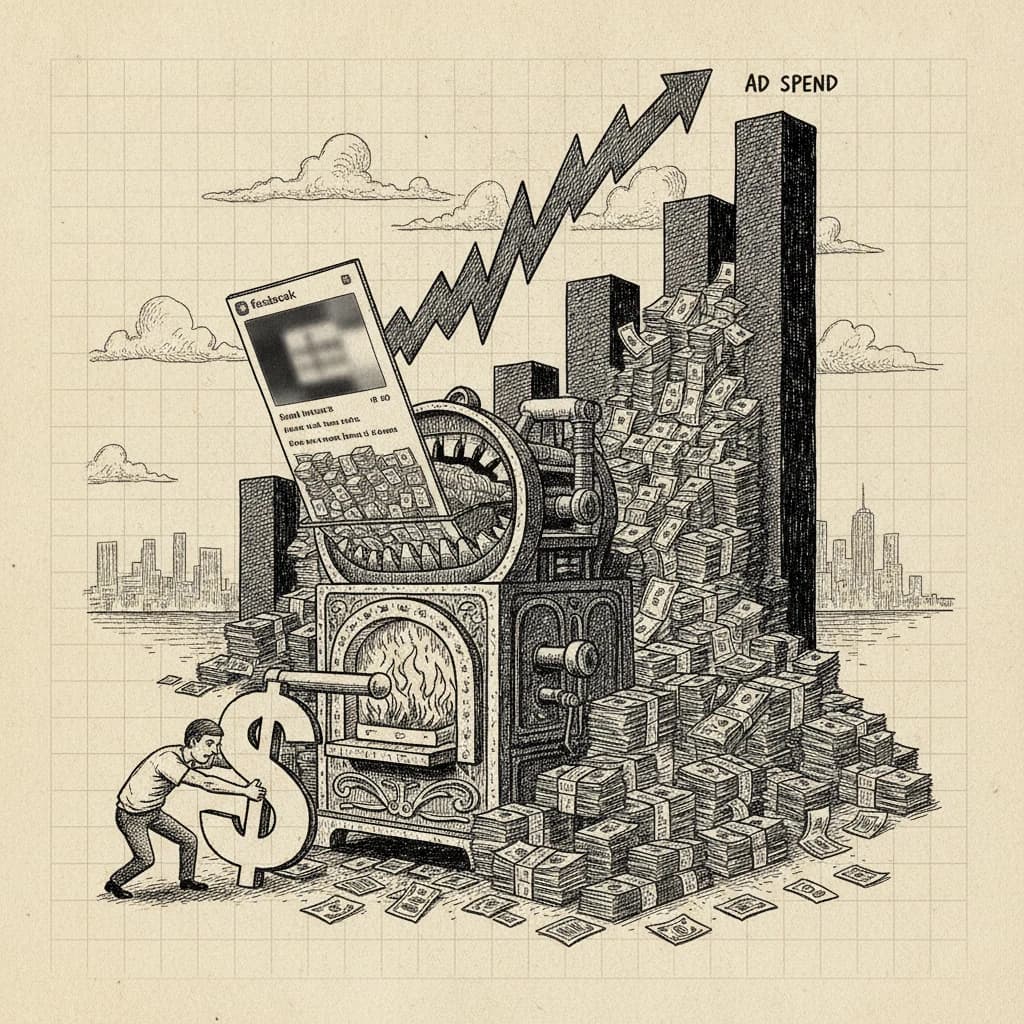
Why Native Static Ads Scale to $100k/Day in Spend
There are DTC brands right now putting over $100,000 a day into a single ad format: native static ads. Not video. Not UGC. A photo and a wall of text. One audited account hired someone full-time just to make them and finds fresh winners every week at that spend level.
That should make you ask: why does this specific, low-tech format have such a high spend ceiling — when polished video creatives so often choke at a fraction of the budget? The answer is a stack of structural advantages, plus one important catch. Understanding both is the difference between riding the wave and getting caught when it breaks.
Reason 1: Camouflage lowers acquisition cost at scale
The core mechanism is Eugene Schwartz's camouflage advertising: an ad that doesn't look like an ad gets past the reader's defenses. At small budgets that just means good CTR. At scale it means something more valuable — as you push spend into colder, broader audiences, obvious ads get more expensive because cold traffic is more defended. Native creative degrades more slowly across that cold audience because it keeps not-looking-like-an-ad. The format's efficiency holds up precisely where scaling usually breaks: the top of the funnel.
Reason 2: Statics are almost free to produce, so you can feed the algorithm
Meta's algorithm is a creative-hungry machine. At $100k/day it needs a constant stream of new creative to fight fatigue, and the bottleneck for most brands is production cost and speed.
A native static is an image plus a text block. With AI copy drafting and AI image generation, a skilled operator can produce and test dozens of genuinely different angles in the time it takes to script, shoot, and edit one video. That production velocity is the real unlock: you can't spend $100k/day if you can only make three creatives a week. Native statics let you generate the volume the algorithm demands — which is why brands staff a full-time role just to keep the pipeline full.
Reason 3: Long copy pre-sells, which lifts back-end economics
High spend is only sustainable if the back-end holds — a great CTR with a broken CPA just loses money faster. Native mini sales letters win here because the ad itself does the selling.
A 1,000–2,000 word mini sales letter drops the reader into a relatable scene, names a mechanism, stacks proof, and walks them to "I need this" before they ever click. So the traffic arriving at your funnel is pre-sold, not cold. Pre-sold traffic converts at a higher rate and tolerates a higher ad cost — which is exactly what lets you keep bidding into more expensive inventory as you scale. Video grabs attention; long-form copy transfers belief. Belief is what survives the click.
Reason 4: It compounds with the right funnel behind it
The brands sustaining nine-figure annual run-rates on this format almost never point the ad at a cold product page. They point it at an advertorial, a listicle, or a quiz funnel that continues the story the ad started.
This is why the economics scale: the native ad builds belief, and the funnel converts it — instead of the ad building belief and the product page throwing it away. A quiz funnel is the most potent version. It takes the desire the ad created and turns it into a personalized self-diagnosis that ends on an offer the prospect feels they requested. Ad opens the loop, funnel closes it. That handoff is what keeps ROAS intact as spend climbs — and it's the part most people skip, then wonder why their native ads don't scale.
The catch: scale invites saturation
Here's the part the "native ads are the new meta" crowd leaves out. Everything above is true and the format has a built-in expiry risk.
If a strategy is easy — copy a prompt, paste it into an AI, generate a fake person, launch — then everyone does it. And when everyone floods Meta with near-identical fake native ads, two things happen: users start recognizing the pattern (the camouflage stops camouflaging), and the platform's detection gets more sophisticated. The edge decays. Brands that built their whole engine on copy-paste fakes watch it stop working overnight — and some get DMCA'd or reported off the platform for ripping images and fabricating personas, losing the brand entirely.
Time doesn't compound in your favor if your advantage is something anyone can replicate in ten minutes.
Who keeps scaling — and who gets wiped out
The brand spending $100k/day durably isn't copy-pasting. They have a real skill set: they understand why native ads work — curiosity gaps, camouflage, belief transfer, mechanism — so they can keep generating genuinely new angles from principles instead of cloning a template. When one hook fatigues, they engineer the next one. That's a moat.
The operator who scaled fast on fake personas and stolen photos has no skill set — just a temporary arbitrage. When it closes, there's nothing underneath. Fast-up means fast-down.
The two types of brands that reach real scale and stay there are the ones that can storytell and the ones that can build product. Native static ads are a storytelling method — one channel for a durable skill — not a business. Treat them as a skill to master, not a hack to milk.
How to scale native ads the durable way
If you want native statics to carry six-figure daily spend without the cliff:
- Learn the principles, not the prompt. Curiosity gap, camouflage, mechanism, slippery slide. Principles let you make the next winner; templates run dry.
- Build on real stories. Authentic testimonials and genuine narratives are what let ad #1 in this category run for eight years. Fabricated personas are a countdown timer and an FTC liability.
- Own your creative. Use imagery you shot or generated for your brand — never ripped photos that invite DMCA takedowns.
- Industrialize production, not deception. Use AI to generate volume of honest angles fast. That's the legitimate superpower — feed the algorithm without cutting corners on truth.
- Put a real funnel behind it. An advertorial or quiz funnel that continues the ad's story is what keeps CPA healthy as spend climbs.
The bottom line
Native static ads scale to $100k/day because they lower cold-traffic acquisition cost through camouflage, cost almost nothing to produce so you can feed the algorithm endlessly, pre-sell through long copy so the back-end holds, and compound when a real funnel closes the loop. But the ceiling belongs to operators with genuine skill and honest creative — the copy-paste crowd is renting a spike that time is working against.
Master the craft, keep it real, and put a converting funnel behind it. Build that funnel in ClarFlow, point your native ads at it, and you'll have an engine that scales and survives.