Best Testosterone Quiz Funnels: How Male-Vitality Brands Diagnose Low T
Men's vitality might be the most quiz-native niche in all of DTC.
Think about why. The problem is embarrassing: no man is asking a store clerk about erection quality. The symptoms are diffuse (fatigue, low drive, softer workouts, worse performance), and any of them can be pinned on "Low T." And the buyer doesn't want a product first. He wants a private, anonymous diagnosis first.
A quiz funnel is the only ad destination that gives him exactly that: a screen nobody else sees, a symptom checklist in his own words, and a "reading" that names a mechanism he can blame. Then, and only then, it prescribes the fix.
That's why this category prints. The prospect does the selling to himself, one tap at a time.
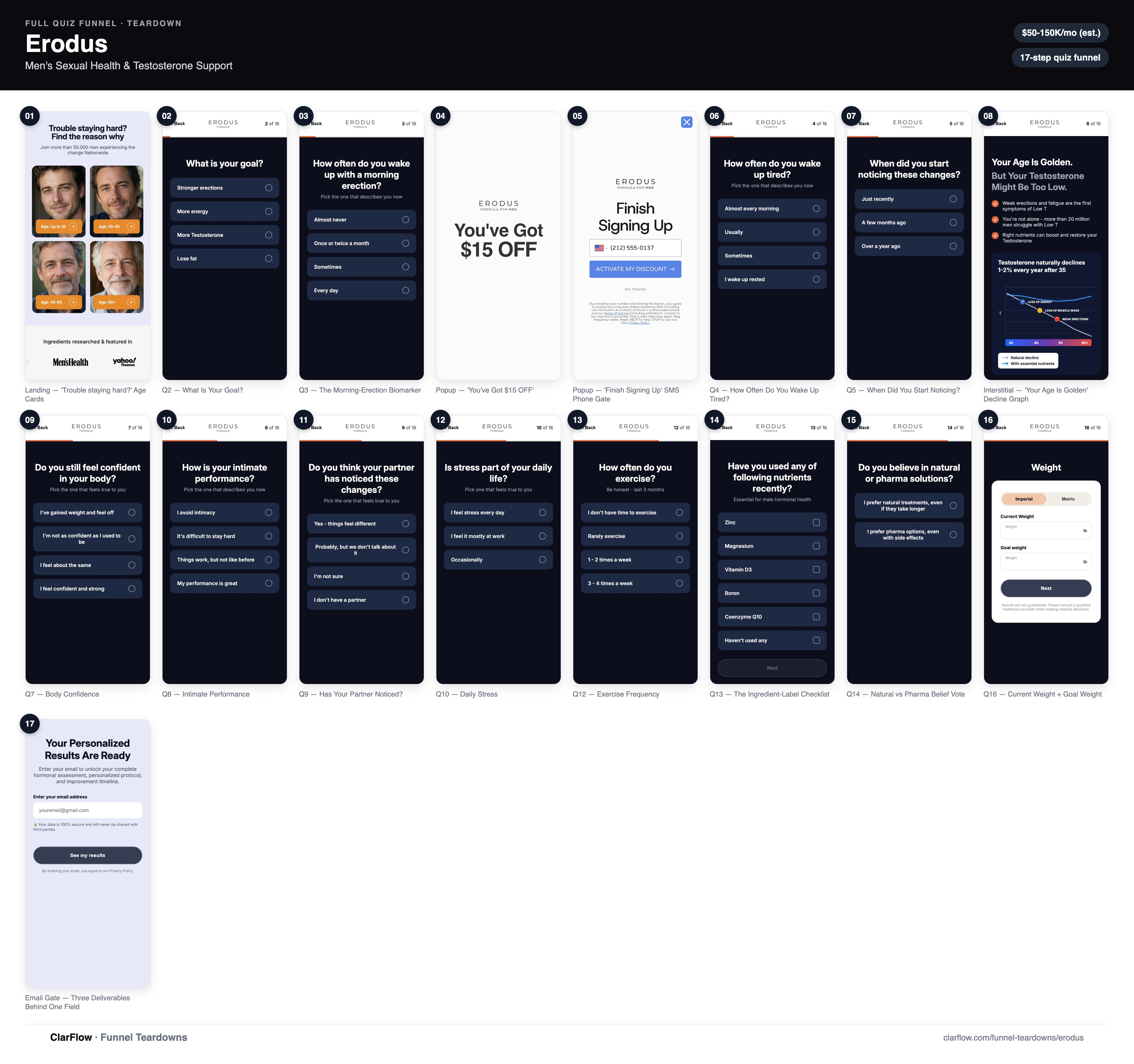
We just published a full screen-by-screen teardown of one of the sharpest examples we've captured: the Erodus quiz funnel, a 16-step hormonal "assessment" from a men's testosterone-support brand. This article pulls the playbook out of it — plus two more men's-health funnels worth studying — and shows you how to build your own version.
What a great testosterone quiz funnel actually does
Read enough funnels in this niche and the same machinery shows up everywhere. Here's what the winners do, with real on-screen copy from the Erodus capture.
1. It names the symptom, not the category. Erodus opens with "Trouble staying hard? Find the reason why" — the bluntest headline in the category. Symptom-first language filters for high-intent sufferers the way "testosterone support" never could. A man with the problem recognizes his problem in the first five words.
2. The first tap is the easiest question you own. Erodus puts four portrait cards of progressively older men on the landing page ("Age: Up to 35" through "Age: 65+"), and tapping one IS question 1. Age is the lowest-friction answer imaginable, it's the funnel's primary segmentation variable, and the four aging faces get the visitor locating himself on a decline curve before a single question has formally been asked.
3. It opens the diagnostic with a real biomarker. Erodus's first symptom question is "How often do you wake up with a morning erection?" — a signal physicians genuinely use to help separate physiological from psychological ED. Leading with it makes the quiz feel like triage instead of marketing, and it quietly frames the problem as hormonal — the one territory a supplement can claim to address.
4. It presupposes the decline. "When did you start noticing these changes?" has no answer that denies the premise. Every option (just recently, a few months ago, over a year ago) confirms that decline is already underway. This is presupposition copywriting, and the best funnels in the niche are full of it.
5. It escalates to a witness. The emotional peak of the Erodus flow is "Do you think your partner has noticed these changes?" — with the devastating middle option "Probably, but we don't talk about it." A private problem becomes a witnessed one, which is the strongest cost-of-inaction lever in men's health. And the funnel immediately follows the shame peak with a stress question: an external, no-fault cause, offered exactly when the prospect most needs one.
6. It seeds the prescription before revealing it. Erodus asks "Have you used any of following nutrients recently?" (Zinc, Magnesium, Vitamin D3, Boron, Coenzyme Q10), subtitled "Essential for male hormonal health." That's the product's own ingredient label disguised as a question. Whatever the visitor checks, the gaps become his deficiency diagnosis.
7. It captures early, and captures everything. Phone number, email, age bracket, symptoms, weight delta — the great funnels in this niche treat every screen as a capture opportunity, and they don't wait until the end to start.
Inside the Erodus funnel: six moves worth stealing
The full Erodus teardown walks all 16 steps with screenshots. Here's the short version — the six moves that make it worth your study time.
The age card that is secretly question 1. No "start quiz" button. The landing page's four aging faces are the quiz entry: one tap on an age card, and the next screen already reads "2 of 16." Commitment begins before the quiz visually does.
Goal before pain. "What is your goal?" (Stronger erections / More energy / More Testosterone / Lose fat) comes before the symptom battery. Every uncomfortable admission afterward reads as progress toward the prospect's own stated goal rather than an interrogation. The four options also map cleanly onto the product's claim stack.
The question-3 SMS ambush. Roughly three taps in, a full-screen popup interrupts: "You've Got $15 OFF," then a second screen — "Finish Signing Up" over a phone field and an "ACTIVATE MY DISCOUNT →" button. The phone number gets banked thirteen questions before the email gate. That's abandonment insurance bolted to the front of the funnel: any mid-quiz drop-off is already recoverable by SMS. The endowment framing ("you've got") means the discount is already yours — the number merely "activates" it.
Interstitials counted as questions. The counter says 16 steps, but three of those slots are educational slides folded into the count. The "6 of 16" screen ("Your Age Is Golden. But Your Testosterone Might Be Too Low.") normalizes (the brand claims "more than 20 million men struggle with Low T"), externalizes (the brand's graph says testosterone "naturally declines 1-2% every year after 35," making it biology's fault, not yours), and pre-sells the mechanism with a "with essential nutrients" curve that holds level while natural decline falls away. It feels like sixteen data points; three of them are the brand talking.
The natural-vs-pharma belief vote. "Do you believe in natural or pharma solutions?" — and the natural option reads "I prefer natural treatments, even if they take longer." Once a man taps that, he has pre-accepted the product category and slow results. Churn-and-refund armor, embedded in an answer option.
A weight delta and a three-deliverable email wall. The final question captures current weight and goal weight (the one number pair that makes any downstream "improvement timeline" feel computed rather than canned), parked at 16-of-16 where sunk cost is maximal. Then the gate: "Your Personalized Results Are Ready," promising a "hormonal assessment, personalized protocol, and improvement timeline." Not "get your results" — three named artifacts, a telehealth-style workup priced at one email address.
One more lesson, from the details: the Erodus landing page claims "more than 50.000 men" while the brand's homepage says 10,000+ — proof numbers that don't reconcile, plus a European thousands separator in a funnel selling "Nationwide" to Americans. Nobody's perfect at 34K visits a month. Reconcile your proof numbers; close readers notice.
For context: Erodus sells a powdered daily drink mix (ashwagandha, Tongkat Ali, cordyceps, L-citrulline, zinc, boron, D3 and more) with subscription-first pricing — $69.99/mo on subscription against $89.99 one-time, bundling down to $44.99/mo. Its teardown radar peaks on Friction (78) and Copywriting (76); Personalization (50) and Offer Strength (55) lag behind, which tells you where the capture machinery outruns the payoff.
More men's-health quiz funnels worth studying
Erodus is the newest capture in our Funnel Teardowns library — but it's not the only one running this playbook.
Mars Men — a 17-step testosterone assessment with an estimated $8–10M in revenue. The move to steal: dual loading screens. The quiz "analyzes your health profile" mid-flow, asks two more questions, then "builds your profile," making one quiz feel like a two-phase clinical assessment, with the questions between the loaders feeling extra diagnostic. It also opens with a skepticism-killing testimonial placed above the age gate, so every visitor reads it before their first tap.
Spartan — an 18-step men's hair-loss quiz with an estimated $5–8M in revenue, running the same diagnostic-to-prescription architecture in an adjacent niche. The move to steal: "Why we ask" explainers under the most sensitive questions (family history, stress), which turn intrusive questions into educational moments and pre-load the mechanism story before the profile page names it. Its severity question ("It's obvious to everyone" vs. "Only I notice") measures the problem by social visibility instead of clinical scales, which is exactly the partner-question lever Erodus pulls.
Different products, same machine: an age gate at the entry, symptom questions framed as diagnostics, mid-funnel interstitials that do the brand's talking, and a personalized-feeling results package at the end.
How to build your own testosterone quiz funnel in Clarflow
Reading teardowns is step one. Shipping your version is the game. Clarflow gives you three ways to get there:
Describe it, and the AI builds it. Clarflow is AI-native: describe your funnel ("build me a 16-step male-vitality assessment for a testosterone supplement targeting men 40+, symptom-first entry, age cards, mechanism interstitial, email gate with three deliverables") and the builder generates a complete, valid funnel you can edit visually. See the AI builder docs.
Clone a teardown. Every funnel in the teardown library ships with a "Clone for my brand" button. Pick the structure that's already been pressure-tested by real ad spend, then swap in your symptoms, your mechanism, your offer.
Let your AI agent do it. Clarflow ships an MCP server: connect Claude or any AI agent and it can create funnels, edit them, publish, and pull question-level analytics programmatically. Your agent reads the teardown, builds the funnel, and iterates on the drop-off data.
Signup is free to start, and pricing scales with the number of visits your funnels get.
FAQ
Are online testosterone quizzes accurate?
No — and that's not what they're for. These are marketing diagnostics, not medical tests. Brands like Erodus use clinically flavored questions (morning erection frequency, fatigue, onset timing) to make the experience feel like triage, but the "hormonal assessment" at the end is a sales instrument. Only a lab blood test actually measures testosterone. If you're building one, keep the disclaimers visible: Erodus runs a full FDA disclaimer on its landing page and "Results are not guaranteed" on its final input step.
What questions should a testosterone quiz funnel ask?
Follow the sequence the winners use: an age card first (zero-friction segmentation), then the prospect's goal before any pain questions, then a symptom battery that starts with a biomarker-style question, then an emotional escalation from self-image to performance to a witness (the partner question), with a no-fault stress question as the relief valve. Close with lifestyle questions, a nutrient/habits checklist that seeds your ingredients, and one typed input (like a weight goal) parked at the very end where sunk cost is highest.
How many steps should a quiz funnel have?
The men's-health funnels in our library run 16–18 steps: Erodus at 16, Mars Men at 17, Spartan at 18. That's longer than most beginners dare, but the length is the point: a 16-step "assessment" earns the right to deliver a personalized-feeling prescription. Note that Erodus counts three educational interstitials inside its 16, so the real question load is lower than the counter implies.
When should a quiz funnel ask for the email?
Later than you think — and it doesn't have to be the first capture. Erodus grabs a phone number at question 3 via a $15-off popup, then holds the email gate until after all 16 steps, where it's guarded by three named deliverables (assessment, protocol, timeline). The rule: capture a recovery channel early, and price the email at the moment your results package is most valuable.
Where can I see real testosterone quiz funnel examples?
The Clarflow Funnel Teardowns library has live DTC quiz funnels captured screen by screen, scored across six dimensions, with step-level analysis, including Erodus, Mars Men, and Spartan.
Steal the machine, not the screenshots
The testosterone niche proves the core thesis of quiz funnels better than any other: when the problem is private and the symptoms are diffuse, self-diagnosis outsells any headline you could write.
Start with the Erodus teardown. Map its moves onto your product. Then open Clarflow, clone the structure, and let your prospects diagnose their way to your offer.