Best GLP-1 Hair Quiz Funnels: How Brands Turn Ozempic Shedding Into Buyers
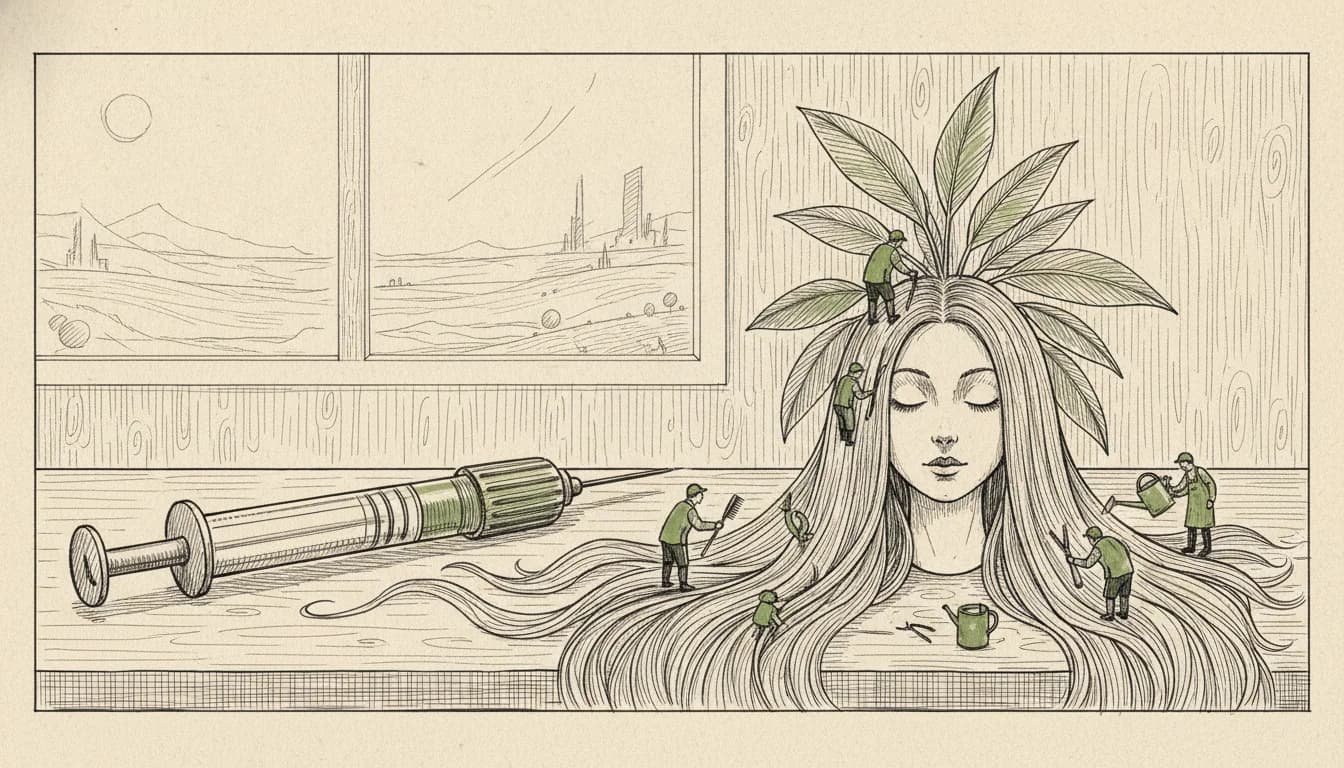
Rapid GLP-1 weight loss is widely reported to trigger a shedding wave, the one people now just call "Ozempic hair," and millions of women are Googling it with no incumbent brand owning the answer.
That gap is being filled by quiz funnels. Not landing pages, not advertorials — quizzes. Because when a woman is quietly panicking about the hair in her shower drain, she doesn't want to be pitched. She wants to be diagnosed.
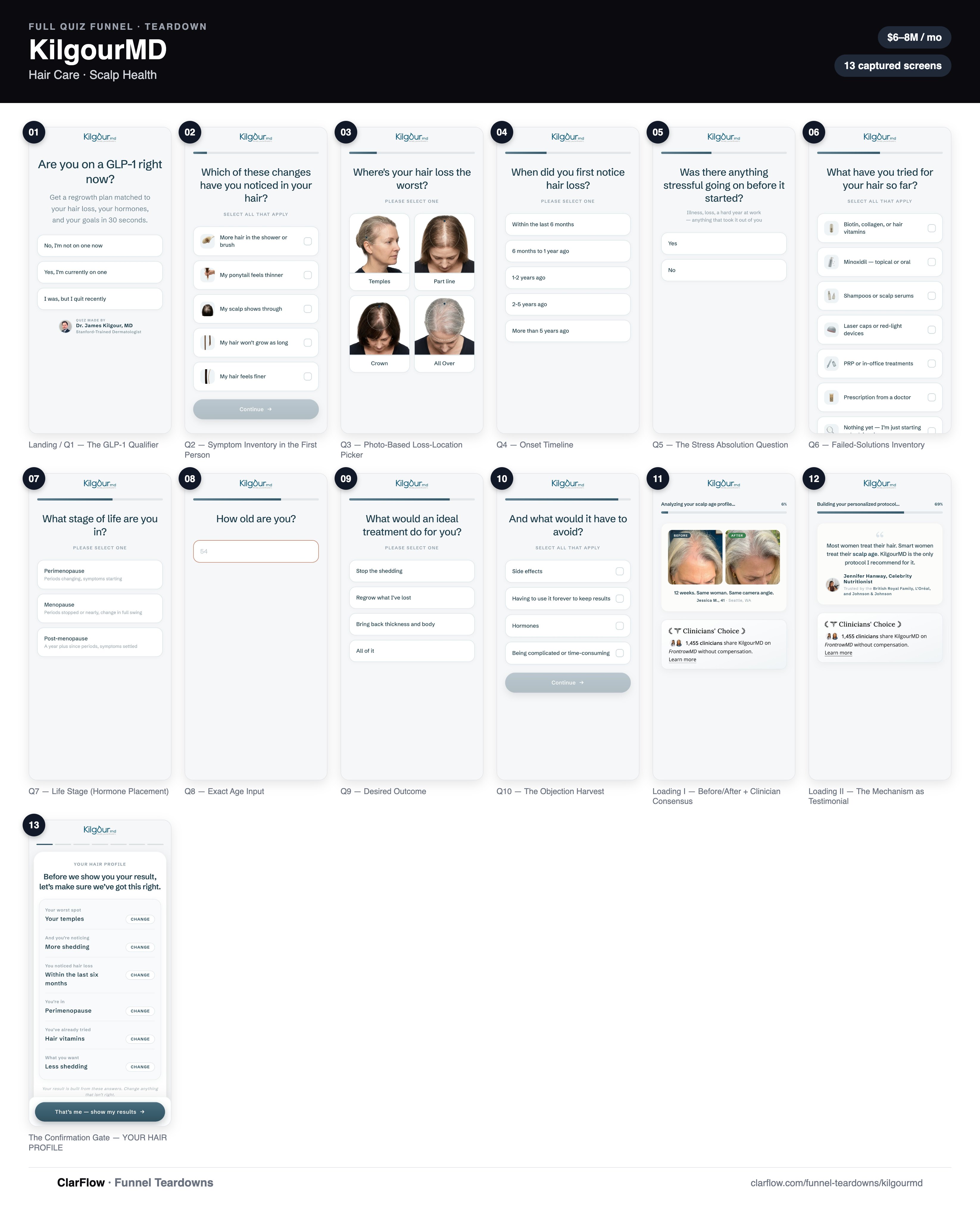
The sharpest operator in the niche right now is KilgourMD, a dermatologist-founded scalp-serum brand with site traffic around 280K that reportedly hit $50M+ ARR within 18 months of launch on just two SKUs. Its funnel opens with a single question: "Are you on a GLP-1 right now?"
We walked that funnel screen by screen, captured 13 screens of it, and scored it. This article pulls out the moves worth stealing, plus three more hair funnels from our teardown library that attack the same buyer from different angles.
What a great GLP-1 hair quiz funnel actually does
Read enough of these funnels and the same architecture emerges. The winners aren't selling shampoo. They're running a diagnostic-to-prescription machine, and every screen has a job.
It qualifies without disqualifying. KilgourMD's opener offers three doors ("No, I'm not on one now," "Yes, I'm currently on one," "I was, but I quit recently") and all three proceed. The GLP-1 hook matches the ad that brought her in, while the "No" door quietly admits the core menopause buyer. Segmentation dressed as screening.
It speaks the prospect's inner monologue. The best symptom questions aren't clinical categories. They're the exact private observations a woman makes in her own bathroom: "More hair in the shower or brush." "My ponytail feels thinner." "My scalp shows through." When an answer option matches her thoughts word for word, ticking the box becomes an act of recognition. And every extra box ticked is severity she self-reported. The funnel never had to claim a thing.
It absolves before it prescribes. Mid-quiz, the register goes tender: "Was there anything stressful going on before it started?" softened by "Illness, loss, a hard year at work — anything that took it out of you." Whatever she answers, her hair loss now has an external cause: stress, hormones, age. Shame exits the funnel; she stays in it.
It harvests objections disguised as preferences. KilgourMD's cleverest question, "And what would it have to avoid?", lists side effects, having to use it forever, hormones, and complexity. Each option maps to a known fear about a rival category. Whatever she selects, the pitch now knows exactly which reassurance to lead with. She wrote the brand's differentiation slide herself, one checkbox at a time.
It installs the mechanism before the diagnosis lands. During the loading sequence, a quote card introduces the brand's proprietary concept ("Most women treat their hair. Smart women treat their scalp age.") as an outside expert's opinion, not as marketing copy. By the time her "scalp age profile" arrives, the frame is already installed.
Inside the KilgourMD funnel: six moves worth stealing
The full teardown covers all 13 captured screens with images and scores. Here's the short version: the six moves that make it work.
1. The qualifier IS the landing page. No hero image, no product shot. The funnel opens cold on the GLP-1 question, a promise line ("Get a regrowth plan matched to your hair loss, your hormones, and your goals in 30 seconds"), and an authorship stamp: "QUIZ MADE BY Dr. James Kilgour, MD — Stanford-Trained Dermatologist," with his headshot. First tap is a medical-intake question, not a "Start Quiz" button. Zero shopping register, and the credential stamp does the trust work of a testimonial wall in one line.
2. A female Norwood scale. "Where's your hair loss the worst?" is answered by tapping one of four photographs of real middle-aged women (temples, part line, crown, all over), each with a dotted diagnostic-annotation circle over the loss zone. Pattern-matching a face like yours replaces translating your scalp into vocabulary, and the casting runs through fully silver hair, so the brand's older core demographic literally sees herself on screen.
3. The failed-solutions inventory. "What have you tried for your hair so far?" lists the entire competitive set: biotin, minoxidil, laser caps, PRP, prescriptions. Every box ticked is a competitor pre-disqualified by her own experience. Crucially, "Nothing yet — I'm just starting to look into it" keeps early-stage researchers in the funnel instead of bouncing them.
4. The four-act loading ceremony. After the last question, the "analysis" runs through four escalating captions ("Analyzing your scalp age profile… Matching to peer-reviewed trial data… Building your personalized protocol… Almost ready…") while proof cards rotate underneath: a before/after captioned "12 weeks. Same woman. Same camera angle." (seven words that pre-rebut before/after skepticism), and a clinician-consensus badge claiming "1,455 clinicians share KilgourMD on FrontrowMD without compensation", a direct strike at the paid-shill objection. Forced dwell time, monetized as a proof reel.
5. The confirmation gate. This is the move almost nobody runs. Before the reveal, a "YOUR HAIR PROFILE" screen echoes six answers back as a labeled chart ("Your worst spot: Your temples"), each with its own CHANGE button, under the caption "Your result is built from these answers. Change anything that isn't right." The CTA: "That's me — show my results." A machine that asks you to verify its inputs feels like an instrument, not a sales page. And "That's me" is a signed identity commitment: she endorses her own diagnosis before seeing it, and consistency psychology makes her far likelier to accept the prescription built from it.
6. The progress bar resets. On that same confirmation screen, the progress indicator restarts as a fresh seven-segment stepper, reframing ten questions of intake as merely phase one and priming her for a multi-step results arc still to come.
The result: our teardown scored it 88 for copywriting and 84 for personalization. The offer behind the funnel is a drug-free two-serum system on subscription, backed by the brand's "give it 90 nights, if nothing grows back you pay nothing" guarantee.
Three more hair quiz funnels worth studying
Rejuveen — fear stats inside the answer options
Rejuveen attacks the same GLP-1 buyer with the sharpest headline in the niche ("Stop the shed. Without quitting the shot.") and a tactic KilgourMD doesn't use: every answer option in question one carries its own risk stat ("Ozempic — semaglutide · 2.5× hair loss risk"), so each tap is a self-administered diagnosis with no safe answer. Add a named five-trigger mechanism anchored to real protein names (GAS6, COL17A1), a skip option on nearly every question, and no email gate anywhere in the captured flow. The takeaway: sell around the drug, not against it. Permission-based positioning plus fear micro-copy inside the options themselves.
Moérie — the diagnostic that ends in a chart-dense prescription
Moérie runs a 13-question hair diagnostic with a gender fork, conditional branching, and an interactive slider where the visitor dials in her own growth target, a number the results page then projects toward with stacked charts before a three-tier bundle close. The takeaway: a self-set goal resists skepticism; nobody argues with a projection toward a number she chose herself.
Frøya Organics — six taps, no email, straight to the offer
Frøya Organics compresses the whole diagnostic into six questions with no email gate at all, using life-stage and family-history questions to build a "root causes" blame narrative, then hands off through a spinner interstitial directly into a 40%-off system offer. The takeaway: friction is a lever. When you're buying cold traffic, every finisher landing on the offer at peak motivation can beat a captured lead.
How to build one in Clarflow
Seeing a great funnel and being able to rebuild it are two very different things. Clarflow closes that gap three ways:
- Clone from the teardowns. Every funnel in the teardown library, KilgourMD included, carries a "Clone for my brand" option, so you start from a structure the market has already voted on and swap in your own angle, mechanism, and offer.
- Describe it, and the AI builds it. The AI builder turns a plain-English brief ("a 13-step hair-loss diagnostic for women on GLP-1s, with a confirmation gate before the results") into a complete, working funnel in minutes.
- Let your AI agent operate it. Clarflow ships an MCP server, so Claude or any AI agent can create funnels, edit them, publish, configure split tests, and pull question-level analytics programmatically.
Personalized results pages, per-step drop-off analytics, and slide-level A/B testing come standard: the exact toolkit these funnels are built from. Pricing is here; every plan includes everything.
FAQ
Does Ozempic really cause hair loss? Shedding after rapid GLP-1 weight loss ("Ozempic hair") is widely reported and heavily searched, which is exactly why this niche exists. The brands attribute it to mechanisms like stress, nutrient shifts, and hormonal change; we analyze the funnels, not the science. What's certain is that millions of women are looking for an answer and very few brands own the query.
What is a GLP-1 hair quiz funnel? A quiz-first acquisition funnel targeting people shedding hair on GLP-1 medications. Instead of a product page, the visitor gets a diagnostic-style intake (medication status, symptoms, life stage, past treatments) that ends in a personalized "result" and a product prescription, usually on subscription.
Why do these brands use quizzes instead of landing pages? Because the buyer's state of mind is diagnostic, not transactional. She's asking "why is this happening to me?" — a question a landing page can't answer and a quiz can appear to. The quiz format also banks segmentation data, objections, and micro-commitments that make the eventual offer feel like a prescription rather than a pitch.
How many questions should a hair quiz funnel have? The funnels above run from six questions (Frøya) to thirteen (Moérie), with KilgourMD at ten plus interstitials. The pattern: as many questions as you can justify with perceived diagnostic value, with an absolution beat in the middle and severity questions that let the prospect build her own case.
Can I copy the KilgourMD funnel structure for my brand? The structure (qualifier opener, first-person symptoms, photo-based self-diagnosis, objection harvest, loading ceremony, confirmation gate) is a pattern, not property. Study the full KilgourMD teardown, then clone the structure in Clarflow and rebuild it around your own mechanism and offer.
Steal the structure, ship your version
The GLP-1 hair wave is the rare moment where demand is exploding faster than brands can claim it. KilgourMD's funnel shows what claiming it looks like: a doctor's intake, not a pitch; a mechanism installed before the diagnosis; a buyer who signs her own prescription.
Start free with Clarflow, open the teardown library, and build your version before the niche fills in.