
Best Hair Diagnostic Quiz Funnels (Torn Down Screen by Screen)
Hair loss is the perfect quiz-funnel niche, and it's not close. The prospect is already running her own diagnostic every single morning — the shower drain, the pillow, the part line in the mirror. She arrives at your ad mid-investigation, desperate for someone to organize the evidence and name the culprit. A hair diagnostic funnel doesn't have to create the fear. It just has to structure it, then prescribe.
Add the GLP-1 wave (millions of women watching their hair shed while the weight comes off) and you get a niche where diagnostic funnels are printing right now, with no incumbent brand fully owning the answer.
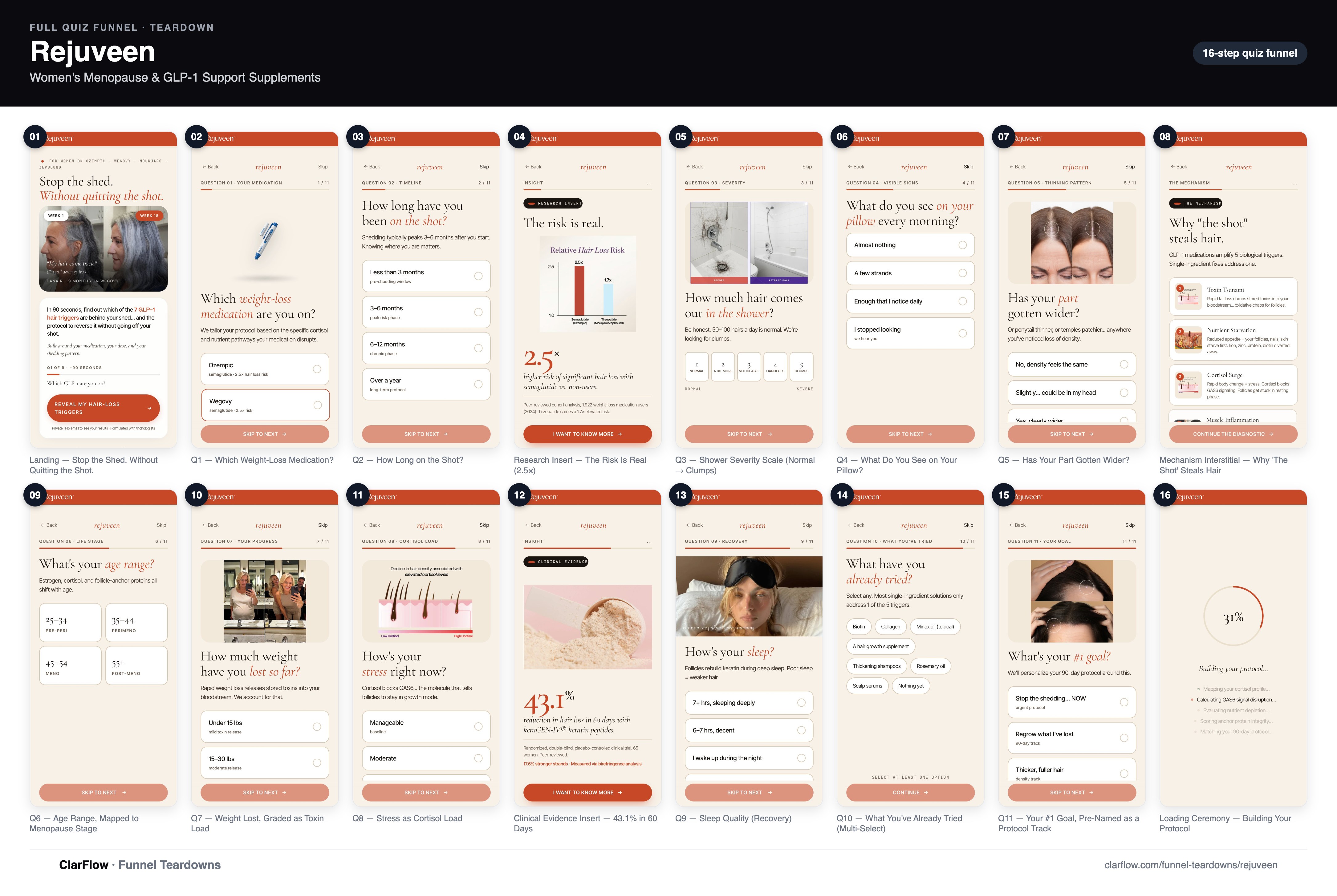
We just tore one of the sharpest examples down screen by screen: Rejuveen's GLP-1 hair-loss diagnostic, an 11-question funnel aimed at women on Ozempic, Wegovy, Mounjaro, and Zepbound. This article pulls the tactics out of that teardown, plus three more hair funnels from the Clarflow Funnel Teardowns library, so you can steal the structure for your own brand.
What a great hair diagnostic quiz funnel does
Rejuveen is an early-stage brand, but the funnel copy is operating at a level most nine-figure brands don't touch (we scored its copywriting 90/100). Six tactics carry it.
1. Side-effect positioning: sell to the shot, not against it. The landing page opens with a category flag ("FOR WOMEN ON OZEMPIC · WEGOVY · MOUNJARO · ZEPBOUND") and the sharpest two-line headline in the niche: "Stop the shed. Without quitting the shot." Instead of competing with the biggest drug phenomenon in a decade, Rejuveen sells around it. The visitor gets permission to keep the thing she's terrified of losing — her weight loss — and the product becomes the companion, not the alternative. Even the before/after testimonial does double duty: "'My hair came back.' (I'm still down 52 lbs.)" defends the weight loss in the same breath as proving the hair claim. Nobody has to choose.
2. Fear stats inside the answer options. Most quizzes treat answers as neutral input fields. Rejuveen turns each one into a one-line fear installment. Question 1 ("Which weight-loss medication are you on?") labels every option with its own micro-stat: "Ozempic — semaglutide · 2.5× hair loss risk," "Mounjaro — tirzepatide · 1.7× risk," even "Other / compounded — still at elevated risk." There is no safe answer. Whichever medication she taps, she simultaneously self-reports and learns her specific drug elevates her risk — severity escalation, one tap at a time, landing as personal diagnosis rather than generic scare copy.
3. Research inserts as belief-shift beats. Twice, the questions pause for a black-badged science interstitial. After Q2, a "RESEARCH INSERT" makes the problem undeniable: a giant serif "2.5× higher risk," cited on-screen to a peer-reviewed 2024 cohort analysis of 1,922 people on weight-loss medication. After Q8, a "CLINICAL EVIDENCE" insert flips to the solution — the brand claims a "43.1% reduction in hair loss in 60 days" for its keratin peptide, cited to a 65-woman placebo-controlled trial. The sequencing is the lesson: problem proof early, solution proof late, never both at once. And both inserts close with "I WANT TO KNOW MORE →" — a first-person micro-commitment where a boring "next" button would be.
4. A named mechanism that pre-kills every competitor. Mid-quiz, "THE MECHANISM" interstitial names five triggers — Toxin Tsunami, Nutrient Starvation, Cortisol Surge, Muscle Inflammation, Anchor Breakdown — anchored to real proteins from published follicle research (GAS6, COL17A1). The framing line is the entire competitive strategy in four words: "Single-ingredient fixes address one." Five questions and a clinical-evidence insert later, the funnel asks "What have you already tried?" and lists exactly those single-ingredient fixes: biotin, collagen, minoxidil, rosemary oil. The prospect ticks off her own failed purchases and personally verifies the mechanism's claim. Everything she's tried becomes evidence she needs a multi-trigger formula.
5. Severity theater with an empathy valve. The severity ladder is written in the prospect's own internal voice — shower shedding runs "NORMAL → A BIT MORE → NOTICEABLE → HANDFULS → CLUMPS," the part-line question ends at "Dramatically... I can see scalp," tagged "urgent." But the funnel catches the emotion it provokes: the most painful pillow answer, "I stopped looking," carries the two-word micro-label "we hear you," converting shame into being-understood at the exact moment it could cause a bounce.
6. Friction as a deliberate lever. Every question but one is skippable via a persistent "SKIP TO NEXT →" button (the lone exception is the mandatory kill list, covered below), and the landing page promises "Private · No email to see your results." An 11-question funnel should bleed completions; Rejuveen trades data completeness for arrival rate at the offer. That perceived freedom is what lets a diagnostic this long run on cold traffic. Our teardown scores its friction 30/100, remarkably low for the depth of data it collects.
Inside the Rejuveen funnel: seven moves worth stealing
The full teardown walks all 16 captured screens with images. Here's the shape of the flow, and the moves that matter:
- Q1 lives on the landing page. The first question is embedded above the CTA ("REVEAL MY HAIR-LOSS TRIGGERS"), so starting feels like answering, not committing. One honest catch our teardown flags: the entry promises "Q1 OF 9 · ~90 SECONDS," but the overlay actually runs 11 questions plus three interstitials; the time cost is quietly undersold at the moment commitment is decided.
- The timeline itself is the threat. "How long have you been on the shot?" grades every answer into a risk phase — "pre-shedding window," "peak risk phase," "chronic phase." Whichever she picks, she's either about to shed, actively shedding, or chronically shedding.
- Three severity questions in a row, each hitting a different daily moment — shower, pillow, part line. The funnel attacks every place she already confronts the shed.
- Success is reframed as risk. "How much weight have you lost?" grades her proudest number as a hazard gradient, from "mild toxin release" to "maximum toxin load." The better she's done on the shot, the worse her diagnosis.
- The age question doubles as menopause staging ("35–44 PERIMENO," "45–54 MENO"), quietly stacking a second risk factor on top of the medication.
- The only mandatory question is the kill list. "What have you already tried?" forces at least one selection — the objection-handling data is worth the friction, everywhere else optional.
- The loading ceremony recites the mechanism back as computation. After the final question, a percentage dial climbs while a checklist completes line by line: "Mapping your cortisol profile… Calculating GAS6 signal disruption… Scoring anchor protein integrity…" It's the five-trigger mechanism, restated a third time, now presented as system activity tied to the answers she actually gave. By 100%, the diagnosis feels earned, and whatever follows is framed as its prescription. (Our capture ends here, at the gate to the results — the offer screens themselves were never captured.)
The final question flips the register from fear to hope ("What's your #1 goal?"), with each answer pre-mapped to a named track ("urgent protocol," "90-day track," "protect + restore"). Fear fills the diagnostic; hope closes it.
Three more hair funnels worth studying
Rejuveen is one of several hair diagnostics in the teardown library. Three neighbors worth your time:
- KilgourMD — a dermatologist-founded scalp brand (reported $50M+ ARR within 18 months) whose landing page is a single question: "Are you on a GLP-1 right now?" All three answers proceed, so the GLP-1 hook qualifies without disqualifying — segmentation dressed as screening, wrapped in medical-intake theater and a "That's me" confirmation gate before the reveal. Takeaway: one intake-style question can replace an entire landing page.
- Moérie — a 13-question diagnostic (est. $15–25M) that forks male/female on the first tap, turns the growth goal into a number with an interactive inch-slider, and sells with charts on a data-dense results page before dropping a 4-product bundle behind a 50%-off countdown. Takeaway: interactive inputs and a chart-heavy results page make personalization feel computed, not asserted.
- Frøya Organics — the opposite thesis (est. $10–20M): the whole diagnostic is six taps, no email gate, no charts, straight into a root-cause interstitial and a 40%-off "lowest price ever" system offer. Friction score: 26/100. Takeaway: if your offer is strong, brutal brevity beats depth.
Read the three side by side with Rejuveen and you can see the real design decision in this niche: how much diagnostic weight your traffic will carry before it wants the prescription.
How to build your own hair diagnostic funnel in Clarflow
Everything above is structure, and structure is exactly what you can clone.
- Start from a teardown. Pick the diagnostic shape in the library that fits your traffic (Rejuveen's depth, Frøya's brevity) and rebuild it in Clarflow with your angle instead of guessing at a blank canvas.
- Or describe it and let the AI build it. Clarflow's AI builder generates a complete, valid funnel from a prompt like "build me an 11-step hair diagnostic for women 45+ with two research interstitials and a loading ceremony," in minutes.
- Or let your agent do it. Clarflow ships an MCP server, so Claude or any AI agent can create funnels, edit steps, publish, configure split tests, and pull question-level analytics programmatically. The mechanism interstitial you want to test against a research insert? That's a prompt, not a project.
Split tests can be configured on a single slide, so you can test one severity ladder against another without rebuilding the funnel — and the results page is assembled per visitor from their answers, which is where the "diagnostic-to-prescription" payoff actually happens.
FAQ
What is a hair diagnostic quiz funnel? A paid-traffic funnel framed as a hair assessment rather than a store: the visitor self-reports symptoms (shedding severity, timeline, what she's tried), the funnel names a root-cause mechanism, and the product arrives as the personalized "protocol" for her results. Diagnosis first, prescription second.
How many questions should a hair quiz funnel have? The winners in our library run anywhere from 6 (Frøya) to 13+ (Moérie, Rejuveen with interstitials). Depth buys personalization and belief-shift; brevity buys completion rate. Rejuveen's answer to the tradeoff is elegant: go long, but make every question but one skippable.
Do hair quiz funnels need an email gate? No — and the strongest new funnels increasingly skip it. Rejuveen promises "no email to see your results" right on the landing page, and Frøya sells straight into the offer. The email gate is a lever, not a default: gate the verdict if lead capture is the goal, drop it if momentum to the offer is.
Why are brands building quizzes around GLP-1 hair loss? Because it's a surging concern with no incumbent owner: a huge audience on weight-loss medications is searching for answers about shedding, and both Rejuveen and KilgourMD built their entry question around the medication itself. The specific risk figures you'll see in these funnels (like Rejuveen's "2.5× hair loss risk" per drug) are the brands' own on-screen claims, cited to research the funnels don't link.
What makes quiz results feel personalized? Reading the visitor's own inputs back. Rejuveen's loading ceremony maps each line to an answer she actually gave — stress becomes "mapping your cortisol profile," weight lost becomes "evaluating nutrient depletion." Specificity is the persuasion.
Steal the structure, not the copy
The hair niche has already voted on what works: side-effect positioning, fear-loaded answer options, a named multi-trigger mechanism, severity theater with an empathy valve, and a loading ceremony that turns marketing vocabulary into computation. It's all laid out screen by screen in the Rejuveen teardown and the rest of the Funnel Teardowns library.
Sign up free, clone the funnel shape that fits your brand, and ship your own diagnostic this week — pricing here, free to start.