Best Longevity Quiz Funnels: Selling the Long Game With a 9-Question Diagnostic
Longevity is the hardest promise in DTC. You're not selling whiter teeth or a faster mile; you're selling a slower decline, to a buyer who can't feel the product working week to week. Which is why the best longevity brands don't sell at all. They diagnose.
A well-built longevity quiz funnel takes the vaguest complaint in commerce (I don't feel like myself anymore) and converts it into a named deficiency with a named fix. The visitor arrives skeptical and leaves holding a "protocol." That reframe, from aging (unfixable) to depletion (fixable), is the entire business model.
The cleanest execution we've captured is Happy Aging, a women's NAD+ longevity brand whose nine-question funnel we just tore down screen by screen. It's not a big funnel: the brand pulls roughly 14K monthly visits and an estimated $20–40K/month. But the craft-per-screen is wildly out of proportion to the size. It scored 88 on copywriting in our teardown radar, and its belief-shift mechanics are some of the sharpest we've captured for the teardown library.
What a great longevity quiz funnel does
Five tactics carry this funnel. All of them travel to any brand selling the long game.
It opens on the diagnosis, not a pitch
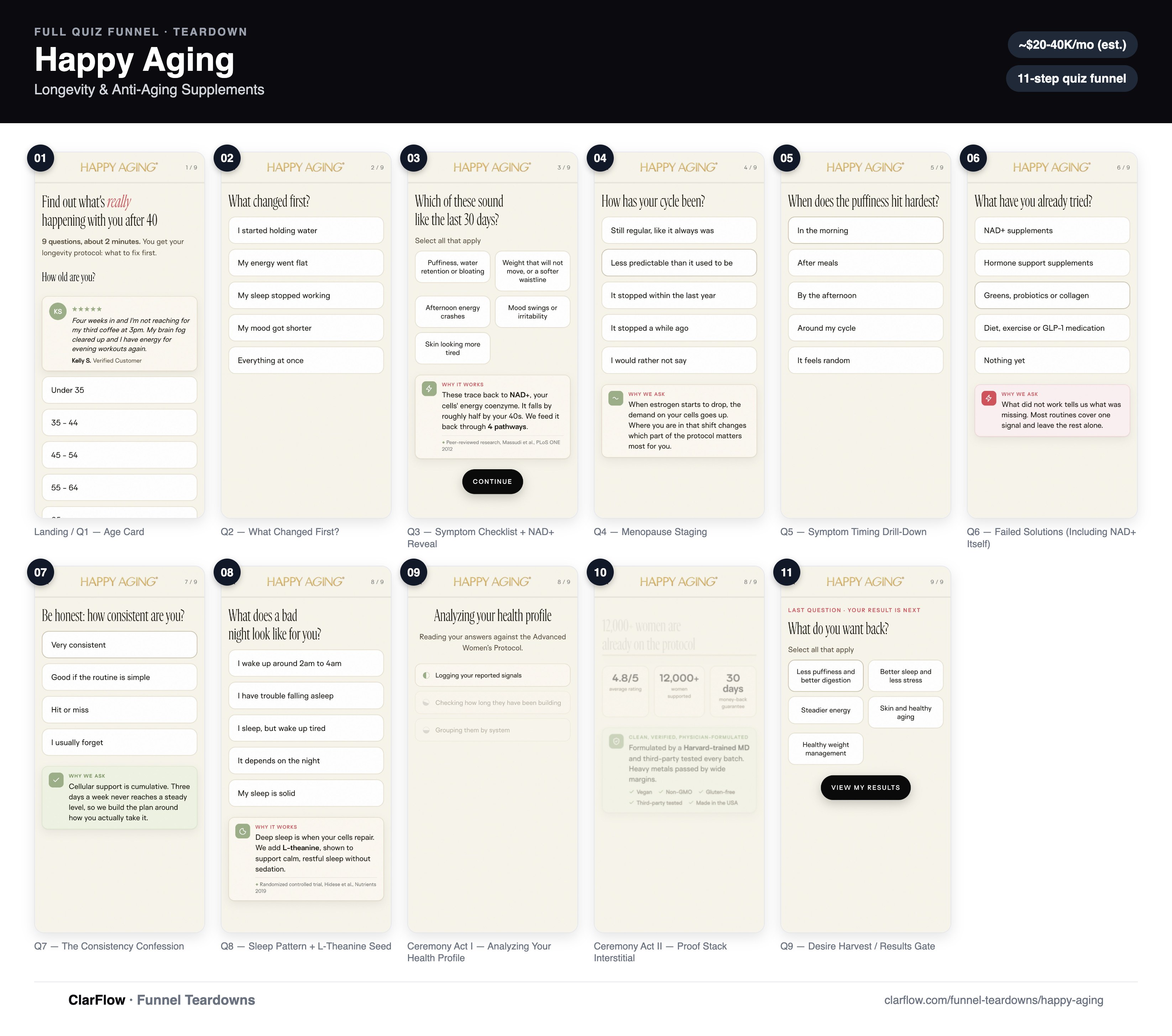
Happy Aging has no hero section, no "Start" button, no landing page in any traditional sense. Screen one is already question 1 of 9: "How old are you?" Above it sits the hook, "Find out what's really happening with you after 40," and one disarmingly honest subline: "9 questions, about 2 minutes. You get your longevity protocol: what to fix first."
Three things are happening at once. The word "quiz" never appears; this is a longevity protocol with a deliverable ("what to fix first"). The time cost is priced up front, so the step counter becomes a kept promise instead of a mystery. And "what's really happening" speaks directly to a woman over 40 whose symptoms keep getting waved off as "just aging." A five-star verified-customer testimonial sits physically between the question and the answer cards, so social proof gets read mid-tap instead of parked on a trust page nobody visits.
It teaches the mechanism at zero step cost
Most funnels that want to educate spend whole screens on it: mechanism interstitials that each cost a tap and a bounce risk. Happy Aging mounts the education inside the questions. Roughly half the screens carry a soft-colored card under the answer options labeled "WHY WE ASK" or "WHY IT WORKS."
On the symptom checklist, the card claims: "These trace back to NAD+, your cells' energy coenzyme. It falls by roughly half by your 40s. We feed it back through 4 pathways," footnoted with a real peer-reviewed citation (Massudi et al., PLoS ONE 2012). The sleep question seeds a second ingredient, L-theanine, cited to a randomized controlled trial (Hidese et al., Nutrients 2019). Whether or not any buyer ever checks the references, the format reads like a medical intake rather than an ad. By the final question she's absorbed the problem, the mechanism, and two named ingredients without the counter moving once.
It collapses five symptoms into one villain
Puffiness, stubborn weight, afternoon crashes, mood swings, tired skin. The funnel spends two early screens gathering that sprawl, then blames every bit of it on a single molecule.
Question 2, "What changed first?", is written entirely in the avatar's own voice: "I started holding water," "My energy went flat," "My sleep stopped working," "My mood got shorter." And the last option, "Everything at once," catches and validates the most overwhelmed (highest-intent) visitor instead of forcing her to rank her suffering.
Question 3 then widens the net with a multi-select: "Which of these sound like the last 30 days?" spans puffiness and bloating, stubborn weight, afternoon crashes, mood swings, and tired skin. It's engineered so almost every woman in the avatar ticks two or more boxes, and every tick is evidence she supplies herself. Then the card underneath resolves the sprawl: all of it, the brand claims, traces back to one depleted molecule.
This is the root-cause convergence play, and it does two jobs simultaneously. It absolves (your symptoms aren't five separate failures of discipline, they're one biochemical event) and it narrows the solution space to exactly what the brand sells.
It names its own category as a failed solution
Question 6 asks "What have you already tried?" and lists "NAD+ supplements" first. The brand's own category, offered as a thing that didn't work.
It looks self-destructive. It's the smartest line in the funnel. "I already tried NAD+ and felt nothing" is the deadliest objection in this market, and Happy Aging converts the prospect who holds it into the ideal customer: ordinary routines, says the warning-red card, "cover one signal and leave the rest alone," while this protocol claims four pathways. Past failures become qualification. There's even a "Diet, exercise or GLP-1 medication" option quietly harvesting the Ozempic-adjacent segment without a single compliance-risky claim.
It pre-sells the subscription before the pitch exists
Question 7 breaks the pattern with a confrontation: "Be honest: how consistent are you?" The card beneath supplies the science-flavored consequence: "Cellular support is cumulative. Three days a week never reaches a steady level, so we build the plan around how you actually take it."
This question isn't collecting data. It's installing the business model. Daily-dose-on-subscription is the store's economics (the shots carry a subscribe discount on-site), and the funnel plants the daily-consistency logic mid-quiz, framed as chemistry rather than a retention tactic. Whatever the offer turns out to be, the reasoning for it is already installed. And every answer is pre-forgiven ("we build the plan around how you actually take it"), so honesty costs the visitor nothing. Confession without penance.
Inside the Happy Aging teardown: the moves worth stealing
The full teardown walks all eleven captured screens with an image of each. The condensed version, the moves you'd actually clone:
- Landing = question one. The first tap is an age card: a zero-thought entry that doubles as the primary segmentation variable, with no start-decision to lose people on.
- An honest contract. "9 questions, about 2 minutes," then a counter that keeps that promise on every screen.
- Education under the answers. The belief-shift sequence rides along at zero added friction, with real citations doing the credibility work.
- Absolution in warning red. "What did not work tells us what was missing." Competitors aren't fraudulent, just incomplete, so the serial supplement buyer stays in the funnel.
- A two-act ceremony that never advances the counter. First "Analyzing your health profile," with a checklist that mimics clinical method ("Logging your reported signals… Grouping them by system"). Then the analysis dissolves into a full-screen proof stack (stat tiles, a physician-formulated card, clean-label badges) delivered at peak attention, while she waits for her result. Both screens still read 8/9.
- A desire harvest as the final gate. 9/9 is "What do you want back?", a multi-select of outcomes ending in a black "VIEW MY RESULTS" button. The visitor ticks the promises the offer is presumably built to echo. And "back" is the sharpest word in the funnel: you can't want back what you never had. Restoration, not enhancement: the core pro-aging position.
- No email gate anywhere in the nine questions. Curiosity, not a form, pulls the buyer through; the funnel posts a friction score of 18 in our radar, versus 56 for Bioma and 55 for Liven. (Our capture ends at the results gate; the results and offer screens weren't observed.)
More funnels worth studying
Longevity is the promise, but the mechanics generalize to every "long game" category: menopause, mental well-being, anything a buyer purchases to feel like themselves for longer. Two adjacent teardowns to read next:
- Bioma — the same root-cause convergence at industrial scale: a 12-question menopause symptom inventory collapsed into one villain ("estrogen-regulating gut flora"), then a "DISRUPTED" verdict page of gauges and projection charts closing a 60%-off subscription behind a countdown. Where Happy Aging is light-touch, Bioma shows the fully weaponized offer stack; it scores 92 on offer strength in our radar.
- Liven — proof that depth itself can be the differentiator: a 42-step well-being assessment with 26 psychological questions, triple authority stacking, and a scratch-to-reveal discount. The opposite bet from Happy Aging's nine questions: friction deliberately spent so the plan feels earned (data depth: 98).
Read them side by side and the lesson is that friction is a dial, not a default. Happy Aging sets it near zero. Liven cranks it until the length becomes the credibility. Both work — for their product. The whole collection lives in the funnel teardown library.
How to build one in Clarflow
Knowing the moves and shipping them are different problems. Clarflow closes the gap three ways:
- Clone from a teardown. Open a teardown like Happy Aging's, pick the structure that fits your product, and rebuild it in Clarflow with AI in minutes: your molecule, your avatar, the same diagnostic spine.
- Generate from a brief. Describe your brand and offer, and the AI builder drafts the full funnel on an editable canvas: the age-card opener, the symptom convergence, the "why we ask" education cards, the ceremony, the desire harvest.
- Drive it from your own stack. Clarflow funnels are structured JSON under the hood (JSON builder docs), and the Clarflow MCP lets Claude or any MCP-capable agent create, edit, publish, and pull analytics on live funnels programmatically. Your agent reads a teardown; your agent ships the funnel.
Start free at clarflow.com/signup; plans and limits are on the pricing page.
FAQ
What is a longevity quiz funnel? A multi-step diagnostic flow that turns a vague "aging" complaint into a specific, named deficiency, then prescribes the brand's product as the fix. The strongest ones never use the word "quiz" (Happy Aging calls its nine questions a longevity protocol), because a protocol implies a deliverable and a quiz implies entertainment.
How many questions should a longevity quiz have? As few as the diagnosis needs to feel earned. Happy Aging does it in nine and declares the cost up front ("9 questions, about 2 minutes"). Liven runs 26 psychological questions across 42 steps for a digital product where depth is the differentiation. The real rule: state the length, show a counter, and make every question visibly feed the result.
Do quiz funnels need an email gate? No — it's a lever, not a requirement. Happy Aging's captured flow shows no email gate across all nine questions; the results reveal itself is the gate. Bioma and Liven both gate the verdict behind an email instead, converting sunk cost into a lead. Decide based on whether your economics need the lead more than the momentum.
Are the health claims in these funnels true? We analyze persuasion architecture, not biochemistry. Claims like "NAD+ falls by roughly half by your 40s" are the brand's on-screen copy; Happy Aging footnotes its cards with peer-reviewed citations, which is itself the tactic worth studying. If you build in a health niche, your claims and your compliance are on you.
Can I copy the Happy Aging structure for a different niche? Yes — the spine (age card → symptom convergence → failed solutions → consistency confession → ceremony → desire harvest) is niche-agnostic. Open the teardown, study the sequence, and clone it into Clarflow with your own mechanism.
Steal the structure, not the molecule
Happy Aging's funnel works because every screen either diagnoses, teaches, or absolves — and the selling happens as a side effect. That structure doesn't care whether your product is NAD+, collagen, or a coaching app. It cares that you name one villain, price the effort honestly, and let the buyer write her own pitch on the last screen.
The blueprint is sitting in the teardown library, screen by screen. Sign up for Clarflow and build your version of it this afternoon.