
The #1 Ecommerce Quiz Funnel Swipe File
Quiz funnels are quietly printing money for the biggest DTC brands on the internet. The problem? You can only ever see them from the outside — one screen at a time, on your phone, after you've already forgotten what screen 3 said by the time you hit the offer.
So we did the boring part for you. We walked the highest-converting ecommerce quiz funnels on the internet end to end, screenshotted every single step, scored them, and laid them out side by side.
The result is the ClarFlow Funnel Teardowns library — the most complete ecommerce quiz funnel swipe file we know of. Sixteen live funnels (and counting) from brands doing anywhere from a few million a month to a $1.2B acquisition, every screen captured and broken down.
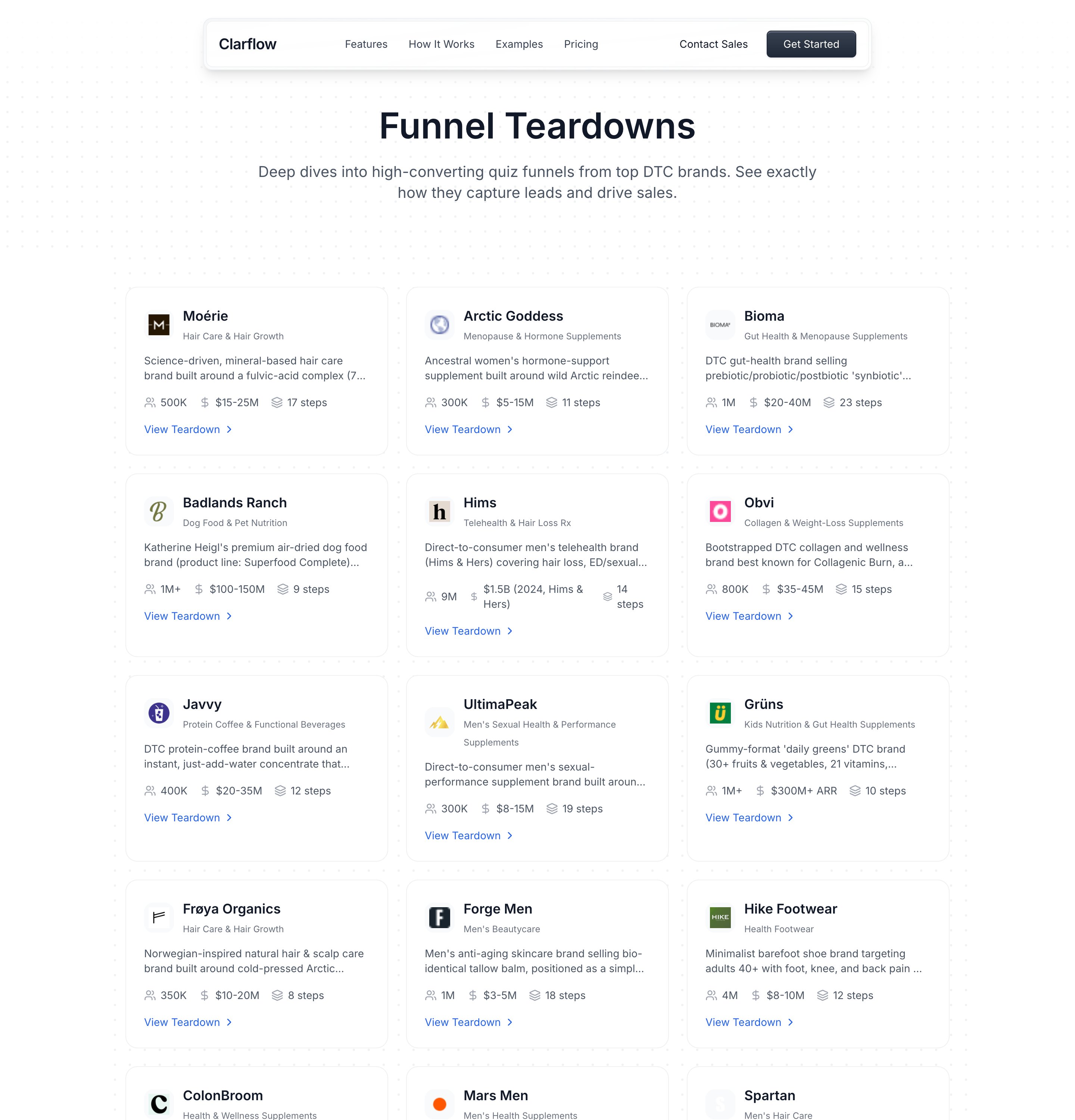
What's actually inside the swipe file
Most "swipe files" are a Google Drive folder of random screenshots. This isn't that. Every teardown in the library gives you:
- The full funnel, screen by screen — from the first tap to the final offer. Nothing skipped, nothing paraphrased. You see the exact questions, the exact order, the exact offer.
- A funnel health score across six dimensions — Visuals, Copywriting, Data Depth, Friction, Personalization, and Offer Strength — so you can see why a funnel works, not just that it works.
- Real business context — estimated monthly revenue, monthly traffic, launch year, category, and step count for each funnel.
- Step-by-step analysis — what each screen is doing psychologically and why it's placed where it is.
- A "Clone for my brand" button — because seeing a great funnel and being able to rebuild it are two very different things.
That last point is the whole game. A swipe file you can only look at is a museum. A swipe file you can clone is a factory.
Why a swipe file beats a blank canvas
Here's the uncomfortable truth about building funnels: the blank page is where most brands lose. They open a builder, stare at "Question 1," and start guessing.
The brands that win don't guess. They model what already works. Every funnel in this library has been pressure-tested by millions of real visitors and millions of dollars in ad spend — the market has already voted on the questions, the sequence, the mechanism, and the offer. Modeling a proven structure and swapping in your own angle is not cheating. It's the single highest-leverage thing a growth team can do.
The swipe file turns "what should question 3 be?" into "here's how eight nine-figure brands handled question 3." That's the difference.
Five funnels worth stealing from
1. Grüns — a $1.2B exit built on a taboo
Grüns went from a 2023 launch to a ~$1.2B Unilever acquisition in under three years. Its kids' line (Grüns Cubs) runs a 10-step quiz that opens on the one thing every parent secretly worries about and no brand talks about: their kid's poop.
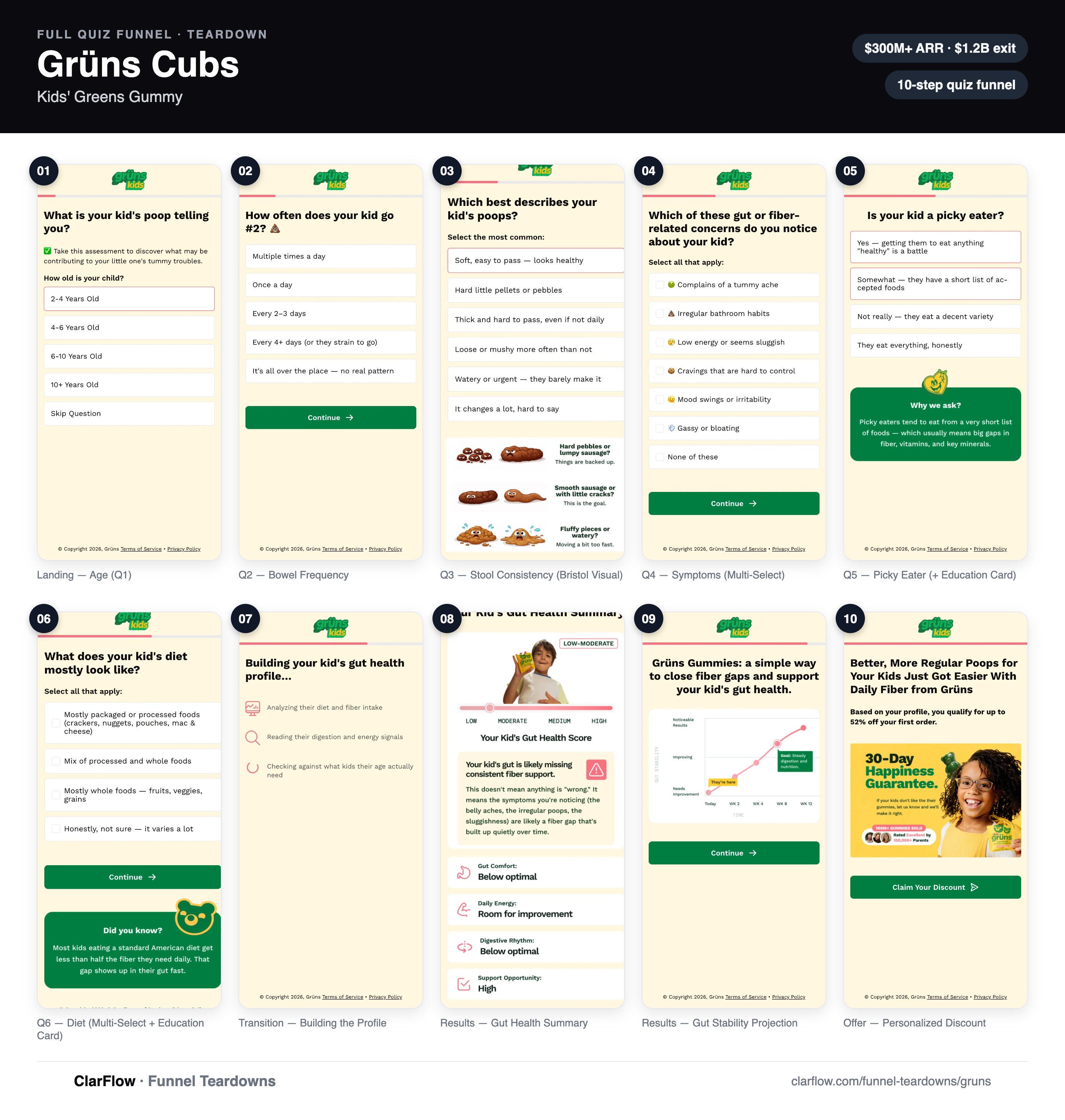
Six questions. A Bristol stool chart. Zero email gate. It plants a "fiber gap" thesis with mid-quiz education cards, manufactures a scored "Gut Health Summary," and converts the diagnosis straight into a personalized discount of up to 52% off. The lesson: a taboo, specific problem beats a generic one — and you don't need an email wall to sell.
2. Hims — reframing a checkout as a medical consult
Hims (part of Hims & Hers, roughly $1.5B in annual revenue) doesn't run a "quiz." It runs a free hair consultation. Same 14 steps, completely different frame.
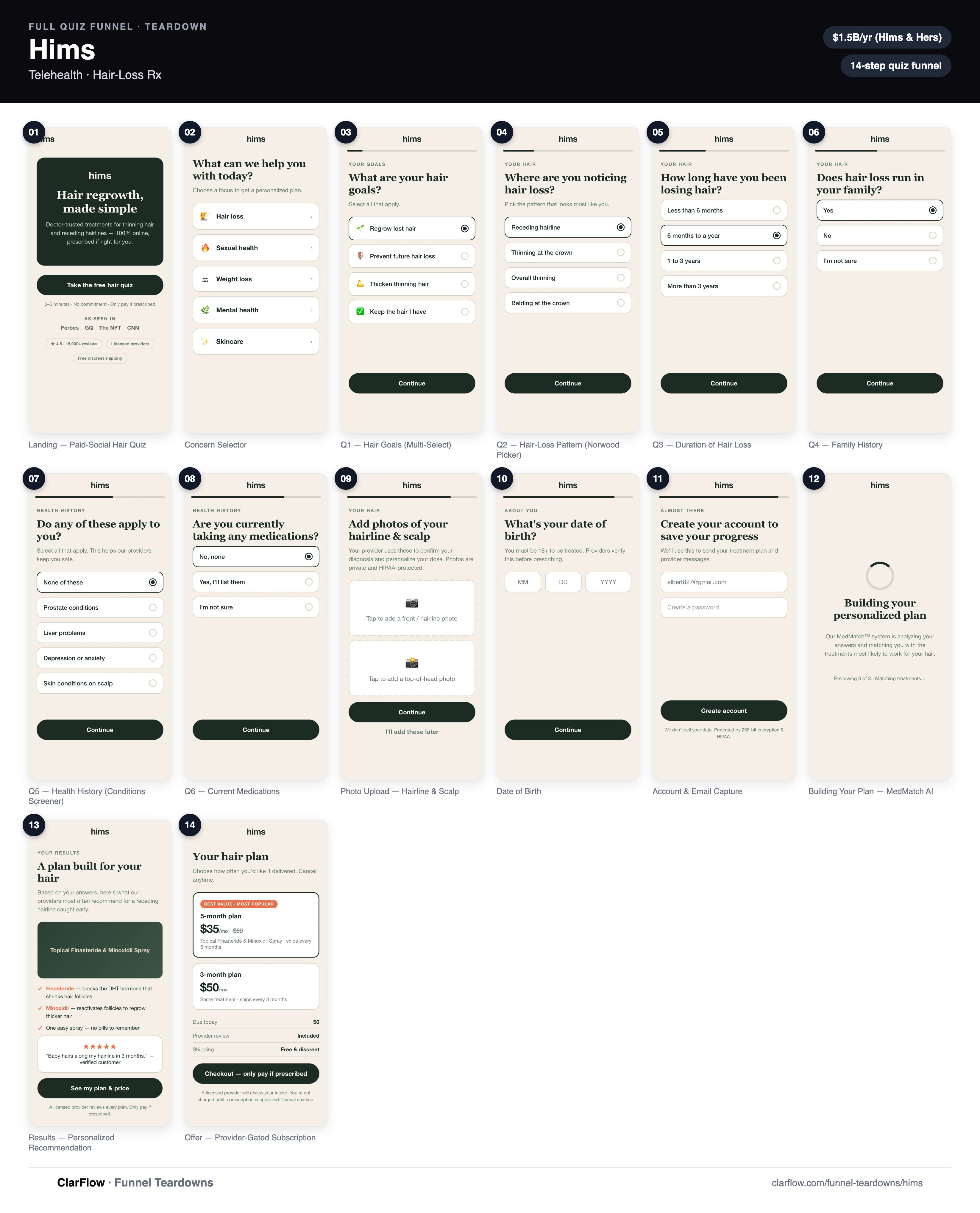
Goals, a Norwood-style hair-loss picker, health-history screeners, a scalp photo upload, and a "MedMatch AI is building your plan" moment — all before you ever see a product. By the time the offer appears, it's not a purchase, it's a prescription. The lesson: the frame you choose ("quiz" vs. "consultation") changes what the buyer thinks they're doing — and how much they'll invest to finish.
3. Badlands Ranch — celebrity + a game you can't lose
Badlands Ranch, Katherine Heigl's dog food brand, does an estimated $100–150M/mo off a 9-step funnel that feels less like a survey and more like a slot machine.
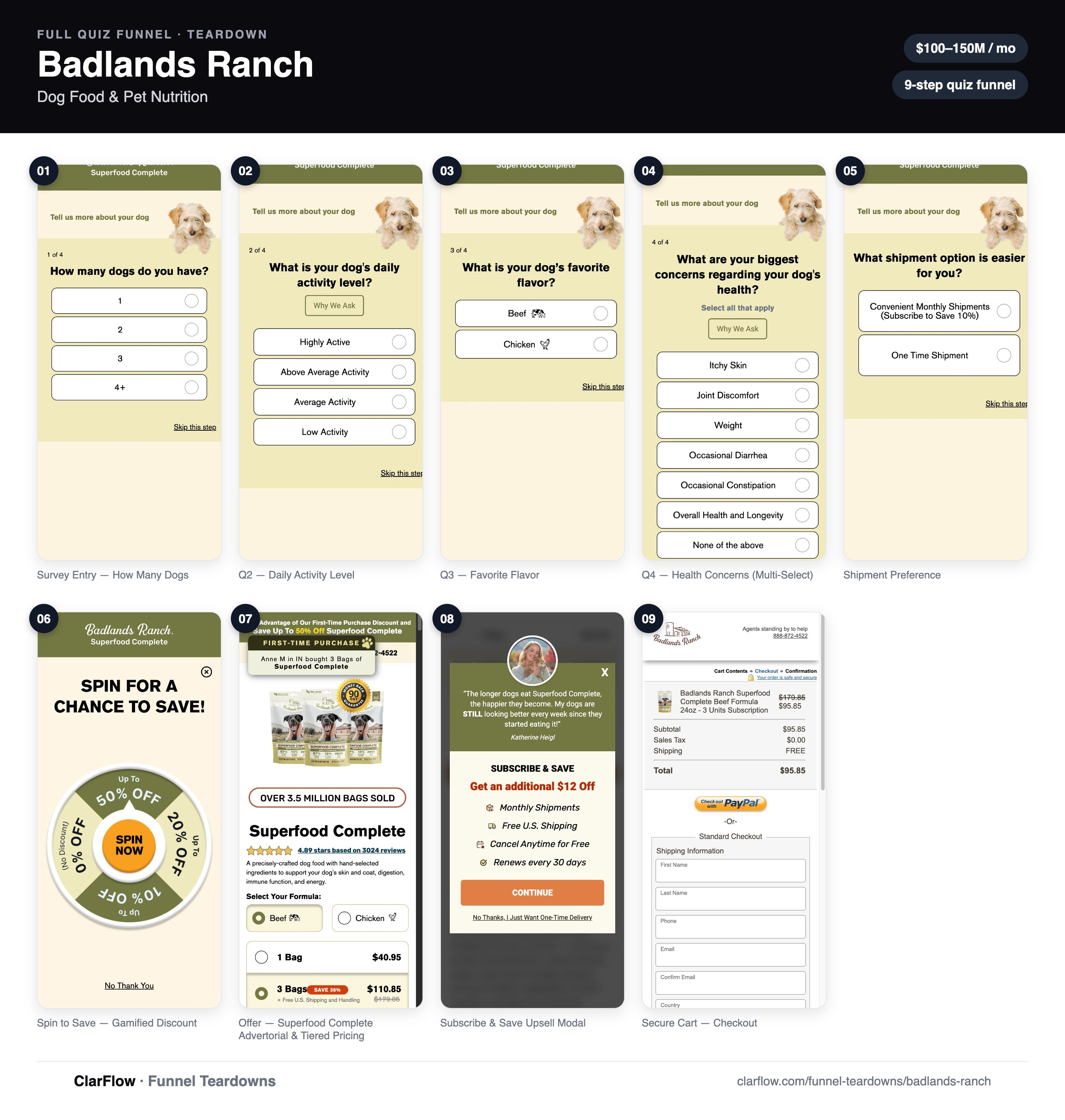
Five friendly taps about your dog, then a gamified "spin to save" discount wheel (you don't get the discount — you win it), a celebrity-anchored advertorial offer with decoy bag-tier pricing, and a subscribe-and-save upsell that intercepts you on the way to checkout. The lesson: a discount you earn feels more valuable than a discount you're handed. Gamification isn't a gimmick — it's a commitment device.
4. Bioma — selling a whole new category
Bioma does an estimated $20–40M/mo by taking a gut-health probiotic and selling it as a menopause solution — a masterclass in category reframing.
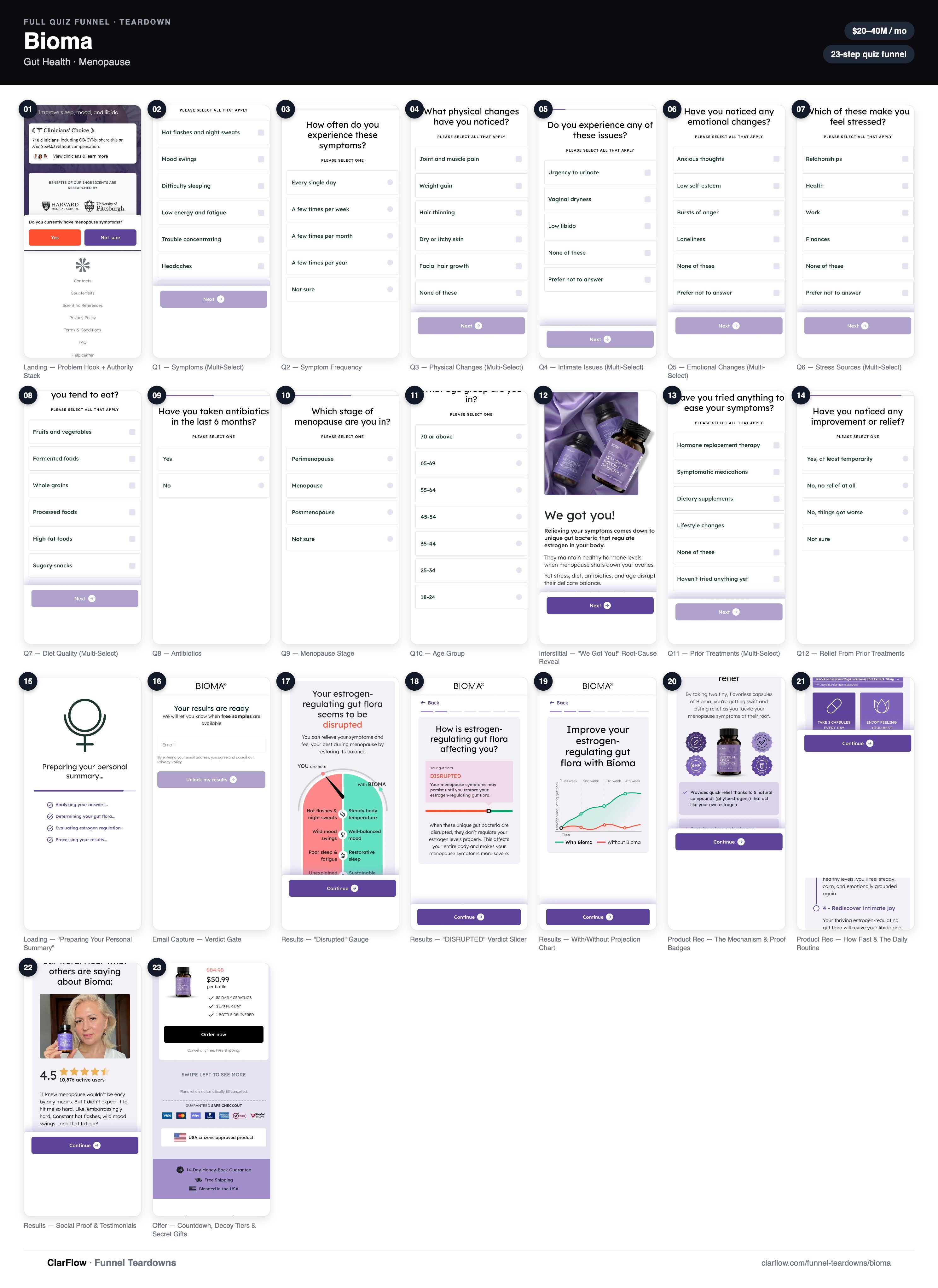
A 12-question symptom inventory feeds a single-villain mechanism ("estrogen-regulating gut flora"), a "DISRUPTED" verdict page stacked with gauges and with/without projection charts, and a 60%-off subscription close behind a countdown and "secret gifts." The lesson: one clear villain plus a results page that shows the problem (gauges, charts, a verdict) does more selling than any amount of copy.
5. UltimaPeak — manufacturing commitment before the pitch
UltimaPeak sells men's performance gummies at an estimated $8–15M/mo — with no landing page at all. Your very first tap is an age selector.
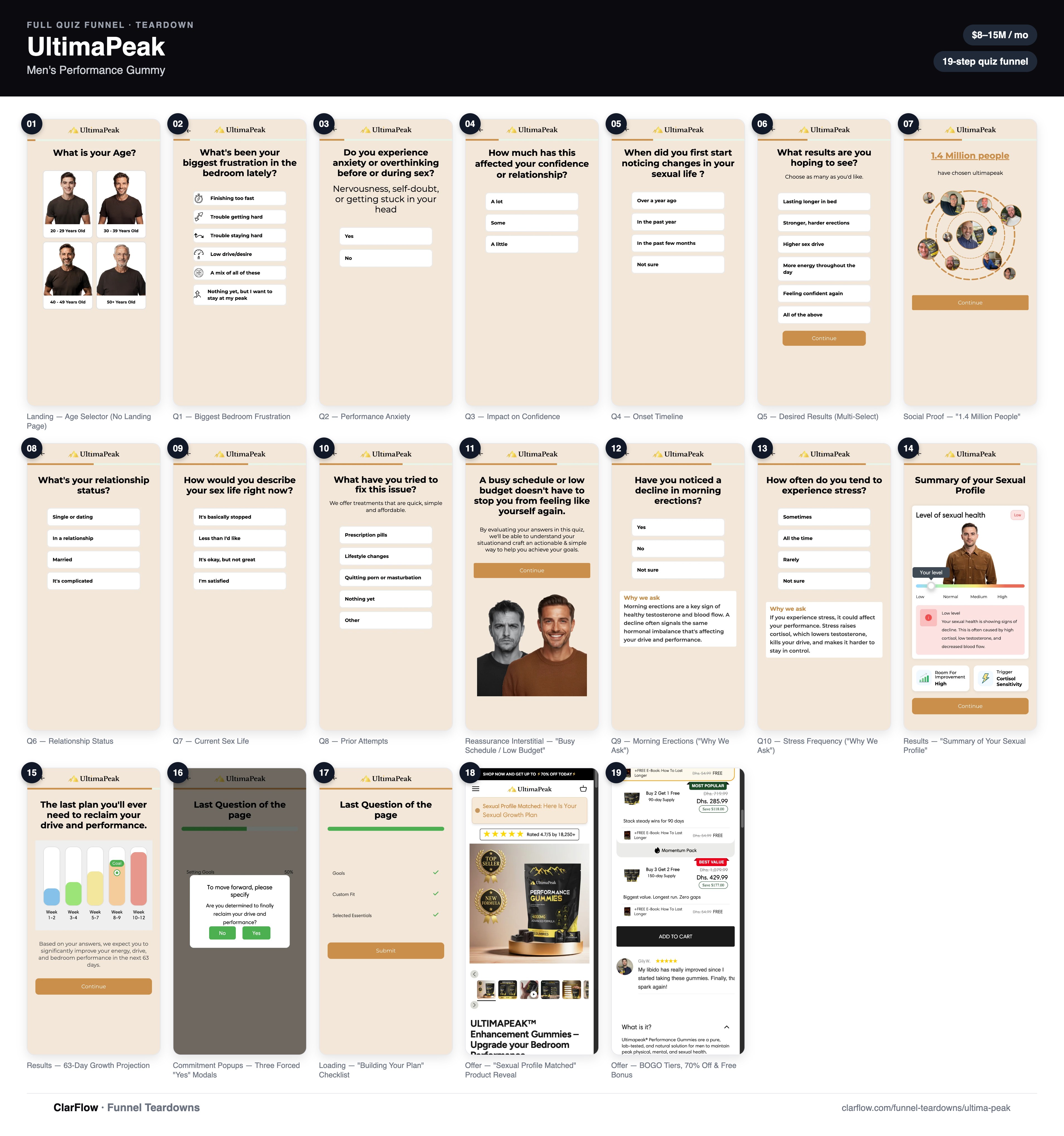
It medicalizes a taboo with "Why we ask" callouts, fabricates a "Sexual Profile" and a 63-day projection, then makes you say "Yes" three times in forced commitment popups before it will even reveal the product — a BOGO bundle at 70% off. The lesson: small, escalating commitments (age → symptoms → three "yes" taps) make the final offer feel like the obvious next step instead of a cold pitch.
The patterns that show up in almost every winner
Read enough of these teardowns back to back and the same moves keep surfacing. This is the playbook the swipe file hands you at a glance:
- No landing page — the first tap is the funnel. The best funnels open on an age card or the first question, not a wall of copy. Starting the quiz is the CTA.
- Diagnose, don't sell. Winners frame the experience as an assessment, consultation, or profile — a diagnostic-to-prescription machine, not a checkout.
- One villain, one mechanism. A single named root cause ("fiber gap," "estrogen-regulating gut flora," "collagen depletion") does the heavy lifting.
- Show the results, don't just claim them. Gauges, scores, verdicts, and with/without projection charts make the problem feel real before the offer.
- Escalating micro-commitments. Age → easy questions → "why we ask" education → a final "are you ready?" tap. By the offer, the buyer is already invested.
- The offer is the payoff, not the intro. Decoy pricing, countdowns, BOGO tiers, and subscribe-and-save land after the diagnosis, when intent is at its peak.
- Friction is a lever, not a default. Several top funnels skip the email gate entirely to keep momentum; others gate the "verdict" to capture the lead. Both are deliberate.
The full teardown library
Every one of these is broken down screen by screen inside the swipe file:
| Brand | Category | Est. scale | Quiz |
|---|---|---|---|
| Grüns | Kids' greens gummies | $300M+ ARR · $1.2B exit | 10 steps |
| Hims | Telehealth & hair-loss Rx | ~$1.5B/yr (Hims & Hers) | 14 steps |
| Badlands Ranch | Dog food & pet nutrition | $100–150M/mo | 9 steps |
| Obvi | Collagen & weight-loss | $35–45M/mo | 15 steps |
| Bioma | Gut health & menopause | $20–40M/mo | 23 steps |
| Javvy | Protein coffee | $20–35M/mo | 12 steps |
| Moérie | Hair care & growth | $15–25M/mo | 17 steps |
| Frøya Organics | Hair care & growth | $10–20M/mo | 8 steps |
| Liven | Mental health app | $8–10M/mo | 42 steps |
| UltimaPeak | Men's performance | $8–15M/mo | 19 steps |
| Hike Footwear | Barefoot health footwear | $8–10M/mo | 12 steps |
| Mars Men | Men's testosterone | $8–10M/mo | 17 steps |
| Spartan | Men's hair-loss | $5–8M/mo | 18 steps |
| Arctic Goddess | Menopause & hormones | $5–15M/mo | 11 steps |
| Forge Men | Men's skincare (tallow) | $3–5M/mo | 18 steps |
| ColonBroom | Gut health & weight loss | $1–2M/mo | 18 steps |
From swipe to shipped
A swipe file only matters if you can act on it. That's why every teardown links straight into ClarFlow with a "Clone for my brand" option — pick the funnel that fits your product, and rebuild its structure with AI in minutes instead of guessing at a blank canvas.
Start here: the ClarFlow Funnel Teardowns library. Find the funnel doing what you want to do. Then go build your version of it.